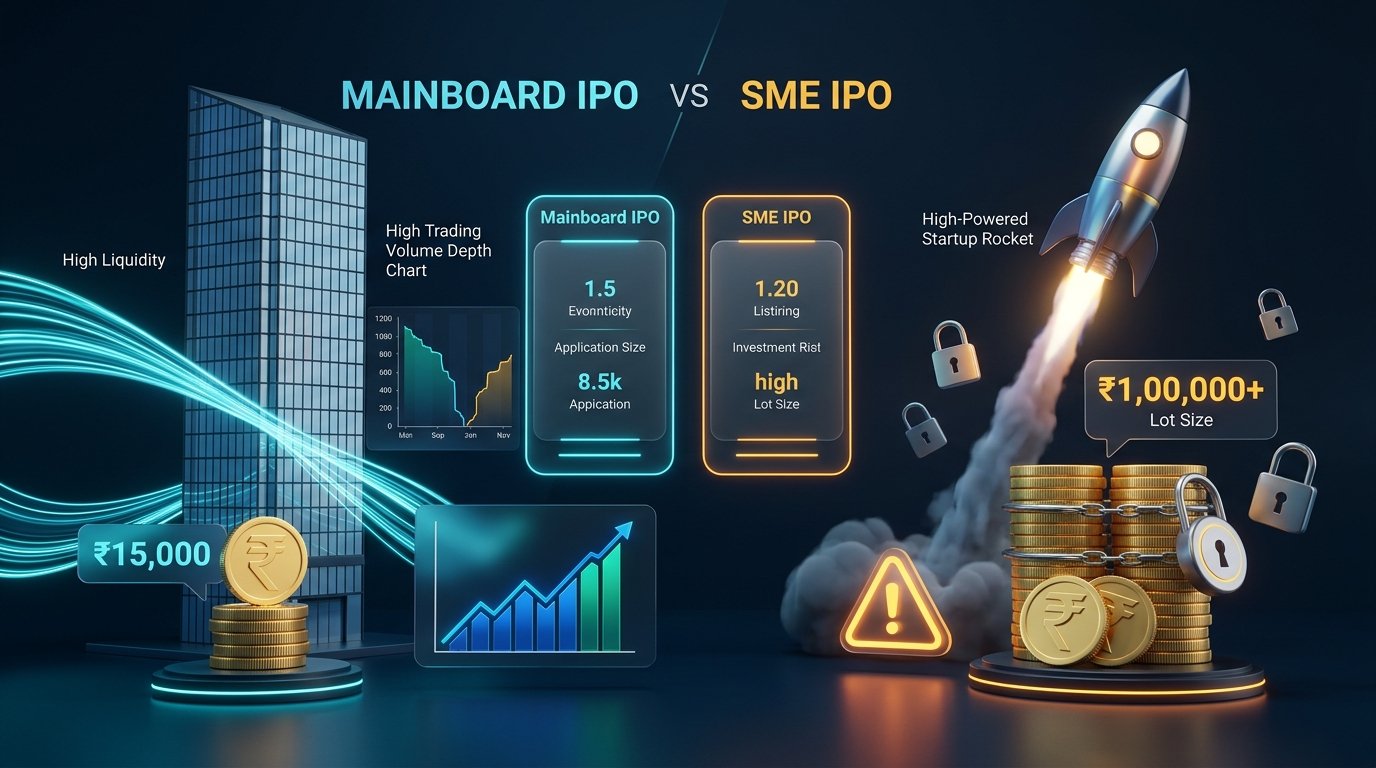
Key Takeaways & Executive Summary
- High Entry Ticket Barrier: Unlike Mainboard IPOs where retail investors can apply with a modest ₹14,000 to ₹15,000, SME IPOs (BSE SME and NSE Emerge) mandate a statutory minimum application ticket of ₹1,00,000 to ₹1,40,000 per lot, designed by SEBI to filter out under-capitalized retail traders.
- The Lot-Trading Liquidity Trap: In the secondary market, SME equity shares do NOT trade as individual shares. They must be bought and sold in full lots (e.g., 1,000, 1,200, or 2,000 shares). If a stock enters continuous lower circuits, exiting your position can become impossible for weeks, trapping capital completely.
- Relaxed Regulatory & Disclosure Standards: SME issuers are not vetted directly by SEBI. Merchant bankers perform the due diligence and file the prospectus directly with the stock exchange and ROC. Furthermore, SMEs report financial earnings half-yearly rather than quarterly.
- Mandatory 3-Year Market Maker Cushion: SEBI ICDR regulations compel the lead manager to appoint a registered Market Maker who must provide continuous two-way buy/sell quotes for at least three consecutive years, absorbing at least 5% of the total issue size.
- Migration to Mainboard: An SME company can migrate to the Mainboard exchange only after completing at least two years on the SME platform, achieving a paid-up capital of at least ₹10 Crores and market capitalization of ₹25 Crores, subject to special shareholder approval.
What is an SME IPO? An SME IPO is a public fundraising mechanism tailored for Small and Medium Enterprises with post-issue paid-up capital between ₹1 Crore and ₹25 Crores, listed on dedicated exchange platforms—BSE SME or NSE Emerge. Operating under relaxed SEBI Chapter IX disclosure requirements and a mandatory ₹1 Lakh minimum lot size, SME IPOs offer explosive micro-cap growth opportunities alongside severe secondary illiquidity and high business-failure risks.
The Micro-Cap Primary Boom on BSE SME & NSE Emerge
Over the past three years, India’s SME public markets have witnessed unprecedented, frenzied activity. Promoters of localized regional businesses—from precision plastic component makers and agricultural equipment distributors to solar installation firms—have tapped the primary markets to raise ₹15 Crores to ₹75 Crores. With subscription figures routinely breaching 200x, 400x, and 800x, retail investors have been captivated by spectacular 100% to 300% listing day gains.
However, behind the euphoric headlines lies a high-risk asset class with structural dynamics that differ radically from blue-chip Mainboard listings. An investor who approaches SME IPOs with the same assumptions used for large-cap Mainboard issues faces catastrophic liquidity traps, circuit lockouts, and permanent capital destruction. To invest safely, one must master the regulatory anatomy of Chapter IX of the SEBI ICDR Regulations.
Structural Comparison: Mainboard IPO vs SME IPO
| Key Feature | Mainboard IPO (BSE / NSE) | SME IPO (BSE SME / NSE Emerge) |
|---|---|---|
| Minimum Application Value | ₹14,000 – ₹15,000 (1 Lot) | ₹1,00,000 – ₹1,40,000 (1 Lot) |
| Secondary Market Trading Mechanism | Trade any single share (Lot size = 1 share). | Compulsory Fixed Lot Trading (e.g. 1,000 shares/lot). |
| Regulatory Vetting Authority | Directly reviewed and scrutinized by SEBI. | Vetted by Stock Exchange & ROC (SEBI does not review DRHP). |
| Post-Issue Capital Ceiling | Minimum ₹10 Crores; No upper limit. | Maximum paid-up capital capped at ₹25 Crores. |
| Financial Reporting Frequency | Quarterly audited/limited review within 45 days. | Half-Yearly financial reporting within 45 days. |
| Market Making Requirement | Optional / Not mandatory for Mainboard. | Mandatory for 3 continuous years by Lead Manager. |
| Underwriting Commitment | Standard underwriting (often non-mandatory). | 100% Compulsory Underwriting (min 15% on Lead Manager). |
The Anatomy of the Secondary Market “Lot-Trading Trap”
The single greatest operational hazard in SME investing is the Fixed Lot Trading Mandate. When you purchase 100 shares of Reliance Industries or Infosys on the Mainboard, you can sell 1 share, 17 shares, or all 100 shares whenever you wish. In an SME listing, however, trading takes place exclusively in predetermined, rigid lot sizes fixed by exchange price bands:
SEBI Standard Lot Sizing Table for SME Stocks
- Stock Price ≤ ₹14: Lot size = 10,000 shares
- Stock Price ₹14 to ₹18: Lot size = 8,000 shares
- Stock Price ₹18 to ₹25: Lot size = 6,000 shares
- Stock Price ₹25 to ₹35: Lot size = 4,000 shares
- Stock Price ₹35 to ₹50: Lot size = 3,000 shares
- Stock Price ₹50 to ₹70: Lot size = 2,000 shares
- Stock Price ₹70 to ₹90: Lot size = 1,600 shares
- Stock Price ₹90 to ₹120: Lot size = 1,200 shares
- Stock Price ₹120 to ₹150: Lot size = 1,000 shares
- Stock Price ₹150 to ₹250: Lot size = 800 shares
- Stock Price ₹250 to ₹400: Lot size = 400 shares
- Stock Price ₹400 to ₹600: Lot size = 250 shares
The Brutal Reality of “Lower Circuit Lockouts”
Suppose you are allotted 1 lot of 1,200 shares in an SME IPO at ₹100 per share (Total investment: ₹1,20,000). On listing day, the stock surges 90% to ₹190. Your position is now worth ₹2,28,000!
However, the following day, negative industry news hits, and the stock hits a 5% Lower Circuit. Because an SME trade requires a buyer willing to commit at least ₹2 Lakhs in a single transaction, the order book dries up completely. There are 25,000 shares offered for sale at the lower circuit, and ZERO buyers.
For the next 12 consecutive trading sessions, the stock locks in 5% daily lower circuits. You place exit orders every morning at 09:15 AM, but because orders execute on a first-in-first-out queue at the exchange, your order remains unfilled. By the time a buyer finally steps in, the stock has plummeted to ₹75—wiping out not only your entire paper gain but inflicting a ₹30,000 net capital loss! This liquidity trap never occurs on Mainboard liquid stocks.
The Market Maker Safety Net: How It Works
To mitigate the extreme illiquidity inherent in small-cap enterprises, SEBI mandates a compulsory Market Maker Architecture for every SME listing:
- Mandatory 3-Year Appointment: The lead merchant banker must contractually appoint a registered Market Maker for a minimum of 36 months from listing day.
- Mandatory Inventory Holding: The Market Maker must subscribe to at least 5% of the total issue size from their own balance sheet to maintain an active inventory of shares.
- Continuous Two-Way Quotes: During trading hours, the Market Maker is legally obligated to continuously quote both a Bid Price (Buy) and an Ask Price (Sell) with a maximum allowable bid-ask spread (typically 4% to 5%) for at least 75% of the trading session duration.
- Execution Guarantee: If a retail investor desires to exit an SME lot and no public buyer exists, the Market Maker is legally compelled to purchase the lot at their quoted bid price, preventing absolute trading halts.
5 Forensic Red Flags Unique to SME IPOs
Because SEBI does not vet SME Draft Prospectuses directly, regulatory scrutiny is significantly more relaxed. Investors must conduct rigorous independent due diligence:
- 1. Sudden Balance Sheet Metamorphosis in Year 3: Be deeply suspicious of companies whose revenues hovered at ₹4 Crores for five years, but miraculously surged to ₹32 Crores with 28% net margins in the single year preceding the IPO filing. In micro-cap enterprises, circular billings between family-controlled entities are frequently deployed to dress up financials for an exit.
- 2. Microscopic Pre-Issue Equity Base & Massive Bonus Shares: Promoters often start with a paid-up capital of merely ₹10 Lakhs. Six months prior to filing the DRHP, they issue an aggressive 1:10 or 1:20 bonus share distribution to artificially expand equity shares, manufacturing an illusion of corporate scale.
- 3. Underwriter Track Record & Merchant Banker Reputation: In the SME space, the merchant banker’s integrity is your primary proxy for safety. Audit the merchant banker’s historical portfolio over the last 3 years: What percentage of their previously listed SME IPOs are trading below their issue price? How many are locked in perpetual lower circuits?
- 4. Single Factory / Single Client Dependency: Over 70% of SME issuers operate out of a single leased factory premises and generate over 65% of their revenue from one or two corporate clients. If that primary customer terminates their vendor agreement, the SME company’s debt servicing collapses overnight.
- 5. Minimal Institutional Participation: If the anchor or QIB book is completely devoid of recognized domestic mutual funds, alternative investment funds (AIFs), or institutional micro-cap funds, relying on retail euphoria alone is perilous.
The Holy Grail: How SME Companies Migrate to the Mainboard
The ultimate multi-bagger outcome in SME investing occurs when a dynamic small business executes on its growth strategy, expands its capital base, and successfully migrates from BSE SME / NSE Emerge to the Mainboard exchange. Upon migration, the restrictive lot-size trading rule is permanently abolished, allowing shares to trade individually, attracting institutional mutual fund inflows and triggering massive valuation re-ratings.
Statutory Criteria for Migration to Mainboard:
- Tenure on SME Platform: The company must have been listed on the SME exchange for a minimum of two full continuous years.
- Paid-Up Capital Threshold: The paid-up equity capital of the company must exceed ₹10 Crores, but cannot exceed ₹25 Crores at the time of migration.
- Market Capitalization Requirement: Minimum market capitalization on the date of application must exceed ₹25 Crores.
- Positive Net Worth & Profit Track Record: The company must have a track record of positive operational net profits and positive net tangible assets across the preceding two financial years.
- Special Shareholder Resolution: Under SEBI ICDR Regulation 277, the migration proposal must be approved by a Special Resolution passed by public shareholders, where votes cast by public shareholders in favor must be at least three times the votes cast against.
SEBI Surveillance Directives & Forensic Scrutiny on SME Exchanges (2024–2026 Reforms)
To curb excessive speculative froth, circular trading rings, and artificial volume manipulation in micro-cap listings, SEBI and the stock exchanges (BSE & NSE) have introduced stringent regulatory frameworks specifically designed to protect retail investors while ensuring capital raising integrity for legitimate enterprises:
- Mandatory 90% Listing-Day Cap: In response to SME stocks surging 200% to 300% during the 90-minute pre-open call auction without institutional backing, stock exchanges instituted a hard 90% price discovery cap over the issue price on listing day. This prevents unregulated grey market hysteria from dictating opening ticks.
- Enhanced Surveillance Measure (ESM Framework) for SMEs: SME securities displaying abnormal price-volume anomalies or extreme volatility are immediately shifted into the ESM framework. Under Stage I and Stage II of ESM, trading is restricted to a 100% upfront margin requirement, narrow 2% to 5% price circuit bands, and periodic call auctions rather than continuous matching.
- Independent Monitoring Agency Mandate: Previously, SME issuers with issue sizes below ₹100 Crores were exempt from appointing a statutory monitoring agency. Under updated directives, SME issuers must deposit all net issue proceeds into monitored scheduled commercial bank escrow accounts. Merchant bankers and independent audit agencies must certify quarterly utilization reports until 100% of the funds are deployed in stated objective capex.
- Stricter Track Record & Minimum Net Worth: Both BSE SME and NSE Emerge have raised the bar for prospective issuers, requiring at least three consecutive years of audited operating profitability, a minimum positive operational cash flow history, and a certified net worth of at least ₹5 Crores to eliminate shell entities from listing.
Calculating Bid-Ask Slippage & Illiquidity Haircuts on SME Lots
The single greatest operational hazard for retail investors participating in secondary SME trading is the invisible cost of the bid-ask spread. Because SME stocks trade in large bundles rather than single units, order book depth is extraordinarily thin. Placing an unhedged “Market Order” instead of a strict “Limit Order” can trigger catastrophic price slippage.
The Bid-Ask Spread Mathematical Formula:
Spread Percentage = [(Best Ask Price – Best Bid Price) / Best Ask Price] × 100
Real-World Case Study of Illiquidity Haircut: Consider an SME stock where the trading lot is 1,200 shares. The order book reflects the best buy bid at ₹122 per share, while the lowest seller is asking ₹136 per share. The immediate spread is ₹14 per share, or 10.29%. If an investor purchases 1 lot at the ask price of ₹136 (total outlay ₹1,63,200) and attempts an emergency exit immediately, they must dump their lot onto the ₹122 bid (realizing ₹1,46,400). That single click results in an instant ₹16,800 illiquidity loss before statutory brokerage, STT, exchange turnover fees, and GST are calculated!
Financial Calculators To Calibrate Your Capital Allocation
Smart risk management dictates allocating only speculative surplus to micro-caps while anchoring wealth in disciplined compounding:
Frequently Asked Questions (FAQs) – SME IPOs vs Mainboard
1. Can I apply for an SME IPO with ₹15,000 like a regular Mainboard IPO?
No! Under SEBI regulations, the statutory minimum application ticket size for any SME IPO on BSE SME or NSE Emerge is at least ₹1,00,000 (and typically ranges between ₹1,15,000 and ₹1,40,000) per lot. Applications below this statutory lot value are legally inadmissible.
2. Can I sell just 10 shares of an SME stock after listing?
No! In the secondary market, SME shares can be bought or sold ONLY in full, multiples of the prescribed lot size (e.g., in blocks of 1,000 or 1,200 shares). Fractional lot selling is completely impossible until the company formally migrates to the Mainboard exchange.
3. Does SEBI review and approve SME IPO prospectuses?
No. Under Chapter IX of SEBI ICDR Regulations, Draft Prospectuses of SME IPOs are NOT vetted or approved directly by SEBI. The due diligence and appraisal are conducted exclusively by the Lead Merchant Banker and the designated stock exchange (BSE or NSE), making independent investor scrutiny vital.
4. How is retail allotment finalized in an oversubscribed SME IPO?
Under SEBI SME guidelines, the net offer is divided into at least 50% for retail investors (bidding up to ₹2 Lakhs) and 50% for non-retail investors. When oversubscribed, a computerized lottery draw is conducted, awarding exactly ONE minimum lot (worth ₹1L to ₹1.4L) to each winning retail applicant.
5. What is the circuit limit on SME stocks on listing day and thereafter?
To curb extreme speculation, stock exchanges mandate strict circuit filters on SME stocks. While listing day discovery can fluctuate, subsequent daily trading is generally restricted to a strict 5% or 10% circuit limit, preventing runaway intraday price swings but exacerbating lower-circuit exit lockouts.
6. How are SME IPO profits taxed under Indian income tax laws?
SME equity shares trade on recognized stock exchange platforms and pay Securities Transaction Tax (STT). Consequently, profits realized within 12 months are taxed as Short-Term Capital Gains (STCG) at 20% under Section 111A, while gains held beyond 12 months qualify as Long-Term Capital Gains (LTCG) taxed at 12.5% under Section 112A above ₹1.25 Lakhs.
7. What percentage of an overall investment portfolio should be allocated to SME IPOs?
Financial planners at JGFundMart recommend that high-risk micro-cap SME equity allocations should never exceed 5% to 10% of an investor’s total liquid financial net worth. The remaining 90%+ must remain anchored in well-diversified mutual funds, blue-chip equities, and sovereign fixed income.