Key Takeaways & Executive Summary
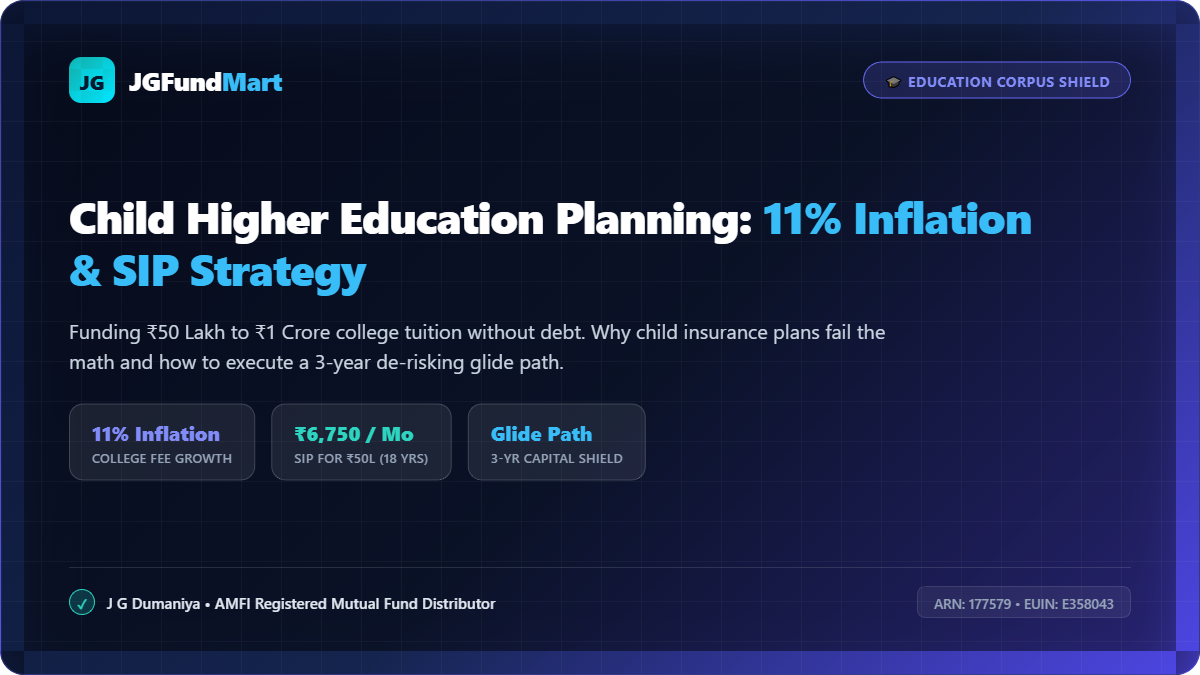
- The 11% Education Inflation Reality: While general retail CPI inflation averages 5% to 6%, premier higher education in India (IIT, IIM, private medical colleges) and foreign universities (US, UK, Canada, Australia) compounds at a brutal 10% to 12% annualized inflation rate. A course costing ₹25 Lakhs today will require over ₹1.2 Crores in 15 years!
- The Traditional Child Insurance Myth: Traditional endowment policies, child money-back plans, and “Child ULIPs” aggressively marketed by insurance agents deliver real-world Internal Rates of Return (IRR) of only 4.50% to 5.50% p.a., guaranteeing a massive 50% to 65% funding deficit at college admission.
- The Golden Separation Principle: Never combine life insurance with child education investing. Purchase a pure Term Life Insurance policy (₹2 Crores to ₹3 Crores sum assured) to guarantee funding in the event of parental demise, and channel 100% of dedicated education savings into well-curated Equity Mutual Fund SIPs compounding at 12% to 14% CAGR.
- The Time-Horizon Compounding Advantage: Starting an equity SIP when your child is born (18-year runway) requires approximately ₹11,500 per month to build a ₹1 Crore corpus. Delaying until the child turns 10 (8-year runway) skyrockets the required monthly SIP to ₹52,000 per month for the exact same target!
- The 3-Year Glide Path De-Risking Protocol: Never leave 100% of your education fund in equities until the final year. Starting 36 months before college enrollment, execute an automated Systematic Transfer Plan (STP) moving 25% of the accumulated corpus each year from Equity to Liquid and Arbitrage Funds, shielding tuition fees from stock market corrections.
- Sukanya Samriddhi Yojana (SSY) Integration: For parents of girl children, maximize the sovereign Sukanya Samriddhi Yojana (SSY) up to ₹1.5 Lakh per year (8.2% tax-free under Section 80C) as an unshakeable sovereign debt foundation alongside equity mutual fund SIPs.
What is Child Higher Education Planning in India? Child higher education planning is the mathematical process of computing the future inflated cost of specialized domestic and overseas university degrees (factoring in 10%–12% educational inflation and INR currency depreciation) and executing a dedicated, goal-based investment strategy. By pairing high-cover pure term life insurance with automated Step-Up Equity Mutual Fund SIPs and a 3-year pre-college debt glide path, parents guarantee 100% college funding without sacrificing their own retirement corpus or forcing children into debt.
The Escalating Crisis: Double-Digit Higher Education Inflation
Among all financial milestones in an Indian family’s lifecycle, funding a child’s higher education carries the highest emotional priority and the fastest compounding cost. Over the past two decades, private universities, autonomous institutes, and premier public institutions across India have restructured fee frameworks to reflect global standards. Simultaneously, an increasing proportion of Indian students aspire to pursue undergraduate or master’s degrees in North America, the United Kingdom, Western Europe, and Australia.
However, the vast majority of parents commit a catastrophic planning error: they estimate future educational costs based on today’s fee brochures or assume normal 5% to 6% retail inflation. In reality, tuition fees, on-campus accommodation, living overheads, specialized research equipment, and international travel inflate at an unrelenting 10% to 12% per annum. Furthermore, for overseas education, long-term Rupee depreciation (~3% to 4% p.a. against the US Dollar) adds an additional compounding layer of cost.
The Mathematics of Educational Cost Escalation (2026 to 2044)
To visualize the future capital requirements, let us model the cost trajectory of five representative academic benchmarks over 5, 10, 15, and 18-year horizons at an average 11.0% annual educational inflation rate:
| Academic Course Benchmark | Current Total Cost (2026) | Cost in 5 Yrs (Child Age 13) | Cost in 10 Yrs (Child Age 8) | Cost in 15 Yrs (Child Age 3) | Cost in 18 Yrs (Newborn Baby) |
|---|---|---|---|---|---|
| Premier Indian Engineering (IIT / BITS / Top NIT) | ₹18,00,000 | ₹30,33,000 | ₹51,11,000 | ₹86,12,000 | ₹1,17,78,000 (₹1.18 Cr) |
| Top Indian B-School (IIM A/B/C 2-Yr MBA) | ₹30,00,000 | ₹50,55,000 | ₹85,18,000 | ₹1,43,53,000 (₹1.44 Cr) | ₹1,96,30,000 (₹1.96 Cr) |
| Private Medical College MBBS (India) | ₹85,00,000 | ₹1,43,23,000 | ₹2,41,35,000 | ₹4,06,68,000 (₹4.07 Cr) | ₹5,56,18,000 (₹5.56 Cr) |
| US 2-Year STEM Masters (Tuition + Living) | ₹70,00,000 | ₹1,17,95,000 | ₹1,98,76,000 | ₹3,34,91,000 (₹3.35 Cr) | ₹4,58,03,000 (₹4.58 Cr) |
| US 4-Year Undergraduate Degree (Ivy / Tier-1) | ₹2,20,00,000 | ₹3,70,71,000 | ₹6,24,66,000 | ₹10,52,58,000 (₹10.5 Cr) | ₹14,39,52,000 (₹14.4 Cr) |
These numbers are not sensationalized; they represent pure mathematical compounding at historical 11% inflation. A parent who sets aside ₹25 Lakhs today in a traditional fixed deposit earning 6.5% interest will find that their money has grown to only ₹64 Lakhs in 15 years, leaving a catastrophic ₹80 Lakh deficit for an IIM MBA or foreign master’s degree!
Forensic Analysis: Why Traditional “Child Insurance Plans” Fail
When a child is born, banks and insurance agents inundate parents with emotionally charged brochures for “Child Gift Plans,” “Child Future Endowment Policies,” and “Child ULIPs.” These products are universally flawed wealth-destruction vehicles for three institutional reasons:
| Evaluation Metric | Traditional Child Insurance / Endowment Plan | Pure Term Life Insurance + Equity Mutual Fund SIP |
|---|---|---|
| Net Annualized Return (IRR) | 4.50% – 5.50% p.a. (Severe real loss) | 12.00% – 14.00% CAGR (Historical equity growth) |
| Life Insurance Cover (Sum Assured) | Only 10x annual premium (e.g., ₹10L cover for ₹1L premium) | ₹2 Crores to ₹3 Crores term cover for ₹15k–₹25k premium |
| Fee Transparency & Cost Drag | High agent commissions (up to 35% in Year 1), mortality fees | Transparent Total Expense Ratio (TER 0.60%–1.50% p.a.) |
| Liquidity & Surrender Penalties | Punitive surrender haircuts; capital locked for 10–15 years | 100% liquid; pause, stop, or step up without penalty |
| Parental Demise Protection | Waiver of Premium (insurer deposits future premiums) | Nominee receives ₹2–3 Cr immediate lump sum cash |
| Final Wealth Outcome (₹1L/yr for 15 Yrs) | ₹23.5 Lakhs to ₹26.5 Lakhs (Deficit!) | ₹47.8 Lakhs to ₹58.2 Lakhs (100% Funded!) |
Step-by-Step SIP Funding Blueprint: Flat vs Step-Up SIP
To fund your child’s higher education milestone, determine your target corpus and time horizon. Below is the mathematical breakdown of the Monthly SIP Required to achieve ₹50 Lakhs, ₹1 Crore, and ₹2.5 Crores assuming a realistic 12.5% CAGR in diversified equity mutual funds:
| Target Education Corpus | Investment Runway | Child Age Today | Flat Monthly SIP (12.5% CAGR) | 10% Annual Step-Up Starting SIP |
|---|---|---|---|---|
| ₹50 Lakhs | 18 Years | Newborn (Age 0) | ₹5,850 / month | ₹2,950 / month |
| ₹50 Lakhs | 12 Years | Child Age 6 | ₹14,950 / month | ₹9,200 / month |
| ₹50 Lakhs | 7 Years | Child Age 11 | ₹36,800 / month | ₹26,400 / month |
| ₹1.00 Crore | 18 Years | Newborn (Age 0) | ₹11,700 / month | ₹5,900 / month |
| ₹1.00 Crore | 12 Years | Child Age 6 | ₹29,900 / month | ₹18,400 / month |
| ₹1.00 Crore | 7 Years | Child Age 11 | ₹73,600 / month | ₹52,800 / month |
| ₹2.50 Crores (Overseas) | 18 Years | Newborn (Age 0) | ₹29,250 / month | ₹14,750 / month |
| ₹2.50 Crores (Overseas) | 12 Years | Child Age 6 | ₹74,750 / month | ₹46,000 / month |
The 3-Year Glide Path De-Risking Protocol
The single greatest operational hazard in child education investing is timing risk. Imagine you successfully compounded an education portfolio to ₹1.10 Crores over 15 years in equity mutual funds. When your child turns 17 and begins taking competitive entrance exams, a global macro crisis or pandemic triggers a sudden 30% stock market crash, instantly shrinking your fund to ₹77 Lakhs right when semester fee demands arrive!
The JGFundMart 36-Month Capital Preservation Glide Path:
- Milestone 1 – Child Age 15 (36 Months to College Admission): Set up an automated Systematic Transfer Plan (STP) moving 25% of total accumulated equity units into a top-tier Arbitrage Fund or Liquid Mutual Fund. This locks in the Year 1 tuition and hostel deposits in zero-risk instruments.
- Milestone 2 – Child Age 16 (24 Months to College Admission): Execute a second STP tranche, shifting another 25% of the portfolio into Short-Duration / Banking & PSU Debt Funds. 50% of the target corpus is now fully insulated from market drawdowns.
- Milestone 3 – Child Age 17 (12 Months to College Admission): Transfer an additional 25% into Sovereign Liquid / Ultra-Short Duration Funds.
- Milestone 4 – Child Age 18 (Admission Year): 75% to 85% of your total corpus is parked safely in T+0 / T+1 debt and liquid instruments. Any final residual equity holding can be redeemed orderly as each subsequent university semester invoice is issued. A market crash on your child’s 18th birthday has zero impact on their college dreams!
Overseas Education Planning: Navigating Currency Depreciation & LRS Rules
For parents planning foreign education (United States, UK, Canada, Europe, Singapore), budgeting requires navigating international foreign exchange and regulatory frameworks:
- USD Rupee Depreciation Hedging: Invest a portion (20% to 30%) of your education portfolio in International Mutual Funds (US S&P 500 / Nasdaq 100 Feeder Funds). Because these funds hold dollar-denominated assets, when the Rupee depreciates against the Dollar, your investment value expands automatically in Rupee terms, perfectly matching your future dollar fee obligations!
- RBI Liberalised Remittance Scheme (LRS) & TCS Rules: Under the RBI LRS window, resident individuals can remit up to USD $250,000 per financial year. Under Section 206C(1G) of the Income Tax Act:
- Education remittances funded via an education loan from a specified financial institution attract a concessional Tax Collected at Source (TCS) rate of 0.50% on amounts exceeding ₹7,00,000.
- Education remittances funded from own self-funded bank accounts attract a TCS rate of 5.00% on remittances exceeding ₹7,00,000 per financial year. (Note: This 5% TCS is not an expense; it can be fully claimed as an income tax credit or refunded upon filing your annual ITR).
Self-Funding via Equity SIP vs Borrowing an Education Loan: The ₹50 Lakh Proof
Many parents rationalize delaying educational savings under the belief: “We can simply take a bank education loan when admission time arrives.” While education loans are valuable as a last-resort financing bridge, relying on debt as your primary plan inflicts catastrophic financial friction on your child’s early career.
The Long-Term Economic Impact on a Fresh Graduate:
- The Education Loan Scenario: A student borrows ₹50,00,000 at a prevailing 10.50% interest rate with a 10-year repayment amortization tenure. The resulting monthly EMI is ₹67,486 per month. Over the decade, the graduate repays a total of ₹80,98,320—paying over ₹30.98 Lakhs in pure interest to the bank! If their starting salary is ₹1,20,000 per month, over 56% of their take-home income is immediately swallowed by debt servicing.
- The Mutual Fund Self-Funded Scenario: A disciplined parent begins an equity SIP of ₹5,900/month (stepped up 10% annually) when the child is born. At age 18, the ₹50 Lakh corpus is delivered completely debt-free. The graduate starts their career with zero liability, allowing them to channel that same ₹67,486 per month into their own wealth compounding, amassing over ₹1.5 Crores in net worth by age 32!
Prioritizing Higher Education vs Grand Wedding Ceremonies
A prevalent cultural tradition in Indian family finance is accumulating physical gold jewelry and locking cash in low-yield fixed deposits decades in advance for grand wedding ceremonies, often at the expense of quality higher education funding. Institutional wealth planners urge parents to re-examine this priority:
- Education is an Appreciating Intellectual Asset: Investing ₹50 Lakhs in world-class higher education enhances the child’s lifetime earning power, professional network, and economic resilience—generating an infinite internal rate of return across their 35-year working life.
- Lavish Weddings are Depreciating Ceremonial Consumption: Spending ₹40 Lakhs to ₹75 Lakhs on a three-day wedding ceremony produces zero financial cash flow, zero intellectual capital, and permanently destroys compounding reserves.
- Avoid Hoarding Physical Jewelry Decades in Advance: Purchasing gold jewelry for a 5-year-old child incurs high making charges (15% to 25%), locker rental costs, and inevitable design obsolescence. By the time the child marries, contemporary fashion trends render the jewelry obsolete, requiring costly melting, remaking, and refining haircuts. Anchor your child’s future in education first!
Financial Calculators To Calibrate Your Capital Allocation
Model step-up monthly SIP investments and calculate future educational costs with inflation:
Frequently Asked Questions (FAQs) – Child Education Planning
1. Which mutual fund categories are best suited for a child’s 15-year education goal?
For an investment horizon exceeding 10 years, build a diversified equity core: 40% in Flexi Cap Funds (multi-cap agility), 30% in Large & Mid Cap Funds (balanced compounding), 20% in Mid Cap Funds (high-growth alpha), and 10% in International Feeder Funds (for currency hedging).
2. Should I invest in the child’s name (Minor Account) or in the parent’s name?
Under Section 64(1A) of the Income Tax Act, any income or capital gains earned on investments held in a minor child’s name are clubbed with the income of the higher-earning parent, eliminating any tax-saving benefit. Investing in the parent’s name (with the spouse as joint holder or nominee) provides superior operational flexibility, simpler KYC, and seamless redemption capabilities.
3. How does Sukanya Samriddhi Yojana (SSY) fit into a girl child’s portfolio?
SSY is an outstanding sovereign debt instrument for parents of girl children (up to age 10 at entry). It yields 8.2% p.a. completely tax-free (EEE status) with annual deposits up to ₹1.5 Lakh. It provides an unshakeable fixed-income foundation for 30% of your daughter’s education portfolio, while the remaining 70% is driven by equity mutual fund SIPs.
4. What happens if the stock market crashes right when my child enters university?
This danger is completely neutralized if you follow the 3-Year Glide Path De-Risking Protocol. By transferring 25% of your equity portfolio annually into liquid and debt funds starting at child age 15, over 75% of your capital is sitting in zero-volatility liquid instruments by admission day, fully immunizing fees from market crashes.
5. How do education loans compare with self-funding via mutual funds?
While Section 80E provides a tax deduction on education loan interest for up to 8 years, servicing a ₹50 Lakh loan at 10.5% interest burdens a fresh graduate with monthly EMIs of ₹65,000+ for a decade. Self-funding via disciplined mutual fund SIPs ensures your child launches their career completely debt-free!
6. Can I claim tax deductions on children’s university tuition fees?
Under the Old Tax Regime, Section 80C allows a deduction for tuition fees paid for up to two children for full-time education in Indian institutions (capped within the overall ₹1.5 Lakh limit). Note: Tuition fee deductions are NOT available under the New Tax Regime (Section 115BAC), nor do they apply to overseas foreign university fees.
7. What is the TCS rate on remitting foreign university fees abroad?
Under Section 206C(1G), foreign remittances for education exceeding ₹7 Lakhs per year attract 5% TCS if funded from self-savings, and 0.50% TCS if funded via an authorized education loan. The TCS amount is fully adjustable against your final income tax liability or refundable upon ITR filing.
8. What if my child secures a 100% scholarship or chooses not to attend college?
Because mutual funds have zero lock-ins or usage restrictions (unlike rigid insurance child plans), you retain complete ownership of the corpus. The accumulated wealth can be seamlessly repurposed to fund their entrepreneurial business venture, purchase their first home, or supercharge your early retirement portfolio!
Explore Related Goal-Based Compounding Masterclasses:
- How SIP Works: The Power of Compounding & Step-Up SIP Wealth Acceleration →
- How to Build a Balanced Mutual Fund Portfolio: Asset Allocation Roadmap →
- Term Life Insurance: Sizing ₹2 Crore to ₹3 Crore Pure Family Protection →
- The 50/30/20 Budgeting Rule Modified for Indian Inflation: Execution Guide →
- Retirement Corpus Planning in India: Rule of 25 & 30 with 7% Inflation →