Key Takeaways & Executive Summary
- Redefining FIRE in India: Financial Independence, Retire Early (FIRE) is not about lounging idly on a beach or never working again; it is the mathematical state of achieving complete time autonomy, where income from your compounding investment portfolio permanently covers 100% of your living expenses without requiring active corporate labor.
- The 4 Primary Indian FIRE Blueprints: Modern Indian FIRE aspirants categorize their journey into four distinct models: Lean FIRE (frugal minimalist living on 25x–30x annual expenses in tier-2/3 cities), Standard FIRE (comfortable urban middle-class living on 33x–38x expenses), Fat FIRE (abundant luxury metro lifestyle on 45x–55x expenses), and Coast FIRE (front-loading compounding in your 20s/early 30s so retirement is 100% funded without future contributions).
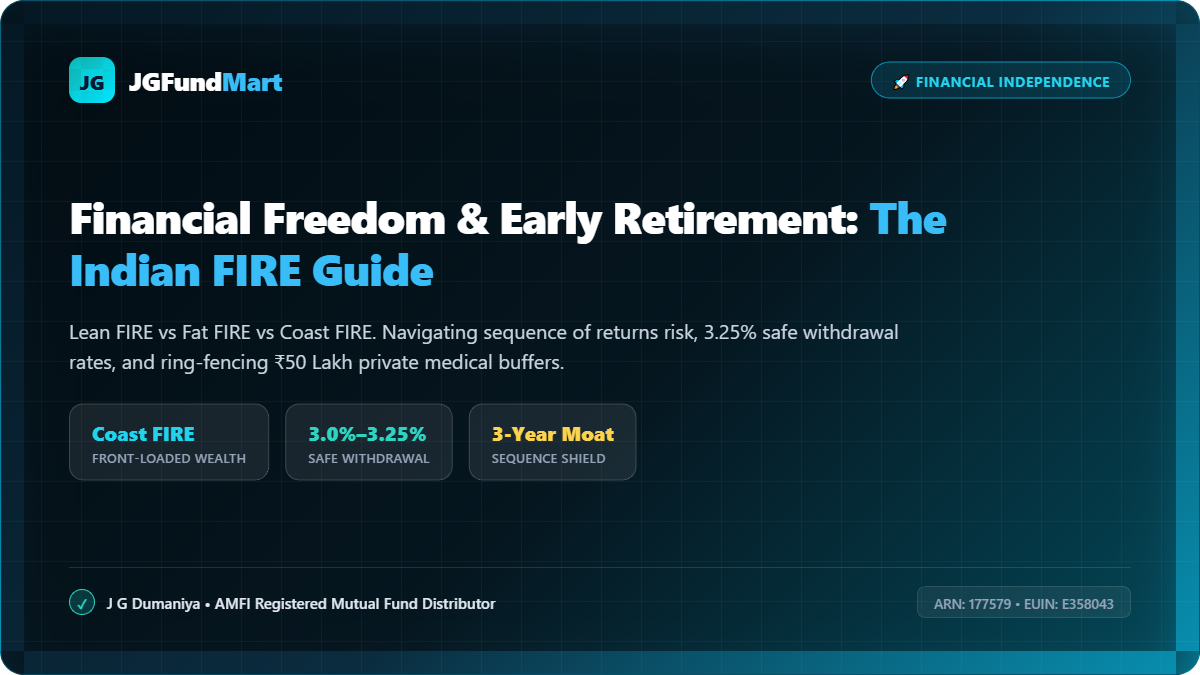
- The Indian Safe Withdrawal Rate (SWR): Because early retirement requires funding a 40 to 50-year post-career lifespan against structural 6% to 7% inflation, the Western 4% Trinity rule is unsafe. In India, a resilient initial Safe Withdrawal Rate must remain strictly between 2.75% and 3.25% (translating into a 33x to 40x annual expense multiplier).
- Immunizing Sequence-of-Returns Risk (SRR): A severe market downturn during the first 3 to 5 years of early retirement can permanently impair portfolio longevity. Conquering SRR requires maintaining a dedicated 3-to-4-year Cash & Liquid Fund Moat alongside dynamic Guyton-Klinger withdrawal guardrails.
- The Standalone Medical & Education Firewalls: Never merge health risks or children’s higher education into your general living corpus. An institutional FIRE architecture demands a debt-free primary residence, a separate ₹1 Crore Super Top-Up health policy with a ₹30 Lakh dedicated medical buffer, and a ring-fenced college education fund.
- SWP Tax Efficiency over Dividends: Relying on dividend-yielding stocks is highly tax-inefficient in India (dividends are taxed at slab rates up to 39%). Generating cash flow via Systematic Withdrawal Plans (SWP) from diversified equity and hybrid mutual funds leverages the 12.5% LTCG tax rate above ₹1.25 Lakh, keeping over 85% of early retirement cash flow tax-free in the initial years.
What is the FIRE Movement in India? The FIRE (Financial Independence, Retire Early) movement in India is an aggressive wealth-accumulation and lifestyle-design framework where individuals save and invest 50% to 70% of their net income into compounding assets (primarily diversified equity mutual funds) to retire decades ahead of the traditional age 60. By accumulating a corpus equal to 33x to 40x of annual living expenses (an initial safe withdrawal rate of 2.75%–3.25%), Indian early retirees fund life autonomy, insulate themselves from corporate burnout, and sustain multi-decade purchasing power against 7% inflation.
The Cultural & Economic Awakening of Indian FIRE
For generations, the standard Indian professional script was rigid and linear: study relentlessly for competitive entrance exams, secure a corporate or government job, purchase an apartment on a 25-year home loan EMI, work continuously until age 58 or 60, and transition into quiet retirement. Over the past decade, however, high-intensity corporate environments, toxic workplace cultures, rapid technological obsolescence, and chronic health burnout have triggered a massive mindset revolution among India’s educated urban workforce.
Corporate professionals, tech engineers, doctors, management consultants, and creators are increasingly refusing to trade the best four decades of their physical vitality solely for monthly paychecks. The FIRE Movement (Financial Independence, Retire Early) represents the deliberate restructuring of your financial life to decouple time from money. In India’s fast-growing economy, achieving financial independence does not require winning a lottery; it requires mathematical discipline, ruthless expense optimization, and the relentless compounding power of equity mutual funds.
Deconstructing the 4 Indian FIRE Blueprints
FIRE is not a one-size-fits-all framework. Your target corpus depends entirely on your desired post-career lifestyle, family obligations, and geographic location across India:
| FIRE Variant | Lifestyle Standard & Location | Corpus Multiplier | Target Annual Expense | Required FIRE Corpus (2026) | Underlying Philosophy |
|---|---|---|---|---|---|
| 1. Lean FIRE | Frugal, minimalist lifestyle in a Tier-2/3 city (e.g., Coimbatore, Indore, Dehradun, Mysore); zero luxury spending | 28x – 30x | ₹6.0 to ₹8.0 Lakhs / yr (₹50k–₹65k/mo) | ₹1.80 to ₹2.40 Crores | Extreme minimalism; high geographical arbitrage; lowest capital barrier |
| 2. Standard FIRE | Comfortable middle-class living in a Tier-1 metro suburb or green city; regular domestic vacations; private healthcare | 33x – 38x | ₹15.0 to ₹22.0 Lakhs / yr (₹1.25L–₹1.8L/mo) | ₹5.00 to ₹8.00 Crores | Balanced lifestyle; zero deprivation; ample margin of safety for 7% inflation |
| 3. Fat FIRE | Affluent, luxury metro lifestyle (South Mumbai, Central Delhi, Bangalore Indiranagar); international holidays, premium cars | 45x – 55x | ₹36.0 to ₹60.0 Lakhs / yr (₹3.0L–₹5.0L/mo) | ₹16.0 to ₹30.0+ Crores | Zero lifestyle compromises; unconstrained spending; legacy wealth transfer |
| 4. Coast FIRE | Front-loading investments in your 20s; working only to cover current living bills without saving for retirement | Early Lump Sum Core | Current active earned income = Current living costs | ₹30 to ₹60 Lakhs at age 28–32 | Immediate career liberation; work low-stress jobs or passion projects while money compounds |
Coast FIRE: The Ultimate Psychological Liberation for Young Professionals
For young corporate employees in their late 20s or early 30s, accumulating a massive ₹6 Crore to ₹10 Crore standard FIRE corpus can feel daunting, leading to cynicism and burnout. Coast FIRE offers the most pragmatic, liberating milestone in modern personal finance.
The Mathematical Magic of Coast FIRE:
Under Coast FIRE, you aggressively save and invest during your initial 6 to 8 career years (living frugally, sharing rent, scaling your skills) until your equity mutual fund portfolio hits a mathematically calculated “Coast Capital Core.” Once you reach this number, you never need to save or invest another single rupee for retirement for the rest of your life!
Required Coast Corpus = Target Retirement Corpus at Age 60 / (1 + r)^Years Until Age 60
Live Example: Suppose you project requiring ₹10.0 Crores at age 60 to retire comfortably. If you achieve an equity mutual fund corpus of ₹30,00,000 by age 28 (32 years of compounding runway at a realistic 12% CAGR):
Future Value = ₹30,00,000 × (1.12)^32 = ₹11,28,45,000 (₹11.28 Crores)!
Your ₹30 Lakhs will compound into over ₹11.2 Crores entirely on its own without you contributing a single extra paisa! At age 28, you can resign from high-stress 70-hour corporate grind jobs, take a 50% pay cut to teach, work at a climate NGO, freelance, or launch an artisanal cafe—because you only need to earn enough to pay this month’s rent and groceries!
The 5 Pillars of a Robust Indian FIRE Architecture
Retiring at age 38 or 42 means your portfolio must survive 45 to 50 continuous years of economic cycles, currency devaluations, technological shifts, and inflation spikes. To ensure you never outlive your wealth, an institutional FIRE plan must rest upon five non-negotiable structural pillars:
Pillar 1: The Inflation-Proof Living Corpus (35x to 40x Multiplier)
Your primary investment portfolio must equal at least 35 to 40 times your current annual household expenses. To outpace 7% consumer inflation, this corpus must maintain a strategic long-term allocation of 60% to 70% in Diversified Equity Mutual Funds (Flexi Cap, Mid Cap, Large & Mid Cap) and 30% to 40% in Debt and Arbitrage Funds.
Pillar 2: A 100% Debt-Free Primary Residence
Never attempt early retirement in India while carrying an active home loan or relying entirely on perpetual residential renting. In Indian metros, landlords frequently raise rents by 8% to 12% annually or demand sudden evictions. Owning a fully paid-off home locks in your shelter cost forever, removing the single largest inflationary expense from your annual budget.
Pillar 3: The Standalone Medical Firewall
Corporate group health insurance terminates the exact minute you tender your resignation. A single severe medical crisis (oncology treatment, organ transplant) in a private Indian tertiary hospital can cost ₹35 to ₹50 Lakhs. Your medical firewall requires: (a) A retail family floater base policy of ₹15–20 Lakhs, (b) A ₹1 Crore Super Top-Up policy, and (c) A dedicated ₹25 Lakh to ₹30 Lakh health contingency fund parked in liquid debt mutual funds, completely isolated from living expenses.
Pillar 4: Ring-Fenced Child Higher Education Funds
Never fund children’s university tuition fees out of your monthly FIRE withdrawal cash flow. University costs arrive as massive multi-lakh lump-sum semester bills. Calculate and invest for children’s higher education as a completely separate, ring-fenced mutual fund portfolio that matures precisely when they turn 18.
Pillar 5: The 3-to-4-Year Cash Moat (Sequence of Returns Defense)
Keep exactly 36 to 48 months of living expenses in non-equity liquid vehicles (Liquid Mutual Funds, Auto-Sweep Bank FDs, Arbitrage Funds). If a global financial crisis or pandemic crashes the Indian equity market by 35%, you do not sell a single equity mutual fund unit at distressed prices. You live off your cash moat for three full years, allowing your equity portfolio to fully recover and reach new all-time highs before harvesting profits!
Passive Cash Flow Engineering: Why Mutual Fund SWPs Crush Dividend Portfolios
A classic mistake made by novice FIRE investors is attempting to construct an “All-Dividend Portfolio” of high-dividend PSU stocks (e.g., Coal India, IOC, REC, PFC). In India, relying on dividend cash flows suffers from severe structural flaws:
The Dividend Tax Disaster:
- Under Finance Act provisions, 100% of dividend income is added directly to your gross total income and taxed at your applicable marginal income tax slab rate (up to 39.00%). If you receive ₹15 Lakhs in annual dividends to fund your living expenses, up to ₹4.5 Lakhs is immediately lost to income tax!
- Companies slash or cancel dividends during economic recessions—precisely when you need stable cash flow the most.
The Mutual Fund Systematic Withdrawal Plan (SWP) Superiority:
- Under an SWP, you instruct the AMC to credit a fixed sum (e.g., ₹1,25,000) into your bank account on the 1st of every month. Each withdrawal is treated as a redemption of units, consisting mostly of your own original capital principal and only a fraction of capital gains.
- Only the capital gain component is taxable—at the concessional 12.50% Long-Term Capital Gains (LTCG) tax rate under Section 112A (with a ₹1,25,000 annual exemption). Over the first 5 to 7 years of early retirement, an SWP yields an effective tax rate of under 3% to 5%, delivering massive post-tax cash flow efficiency!
Dynamic Withdrawal Rules: The Guyton-Klinger Guardrails
Rigidly withdrawing an identical inflation-adjusted rupee amount every single year regardless of market conditions increases your probability of portfolio exhaustion. Sophisticated early retirees employ Guyton-Klinger Dynamic Guardrails:
- The Capital Preservation Rule: If your current withdrawal rate rises more than 20% above your initial target (e.g., market crash increases withdrawal rate from 3.0% to 3.8%), reduce your monthly discretionary spending by 10%. Skipping an international vacation during a bear market year adds years of longevity to your corpus.
- The Prosperity Rule: If a massive multi-year bull market expands your portfolio, dropping your withdrawal rate 20% below initial target (e.g., from 3.0% down to 2.3%), you can safely grant yourself a 10% lifestyle raise!
Financial Calculators To Calibrate Your Capital Allocation
Simulate your personalized early retirement number, model monthly SWP cash flows, and test compounding runways:
Frequently Asked Questions (FAQs) – FIRE Movement in India
1. What is the minimum corpus required for Lean FIRE in India?
For a frugal individual or minimalist couple living in a Tier-2/3 Indian city (with a fully paid-off home and no children), Lean FIRE can be executed with a corpus of ₹1.80 Crores to ₹2.50 Crores. This supports a monthly living expense of ₹45,000 to ₹60,000 at a conservative 3.0% safe initial withdrawal rate.
2. Can someone earning ₹1.2 Lakh per month achieve FIRE in India?
Yes! If an individual earning ₹1.2 Lakhs net saves and invests 60% (₹72,000/month) into disciplined equity mutual fund SIPs stepped up 10% annually, their portfolio will compound to over ₹5.2 Crores in approximately 14 years (assuming 13% CAGR), enabling a full Standard FIRE retirement in their early 40s!
3. Why does the Western 4% Rule fail over a 45-year Indian retirement?
The American 4% Trinity rule assumed a 30-year horizon with 2.5% inflation and state social security. Retiring at age 40 in India requires funding a 45+ year lifespan against 6% to 7% inflation and double-digit healthcare costs. A 4% withdrawal rate carries a high probability of capital depletion by age 70; a 2.75% to 3.25% SWR is mathematically mandatory.
4. How do early retirees get comprehensive health insurance without an employer?
You must purchase a private retail family floater policy while you are still young and healthy in your 30s before any pre-existing illnesses (hypertension, diabetes) emerge. Structure this with a ₹15 Lakh base policy and a ₹1 Crore Super Top-Up cover (with a ₹15 Lakh deductible), keeping total annual premiums under ₹30,000 to ₹40,000.
5. What is Barista FIRE and how does it operate in the Indian context?
Barista FIRE involves accumulating 60% to 70% of your full FIRE corpus and leaving full-time high-stress corporate employment to work in a low-stress, flexible part-time role (consulting, teaching, freelancing, running an e-commerce store). Your part-time income covers 50% of monthly groceries and utilities, dramatically lowering portfolio withdrawal pressure while your core corpus compounds untouched.
6. Should I pay off my home loan completely before initiating FIRE?
Yes, absolutely! Entering early retirement with an active home loan EMI forces you to make large mandatory monthly cash withdrawals regardless of whether stock markets are in a severe crash. A fully paid-off home eliminates mortgage risk and drops your required monthly living expense to baseline subsistence.
7. What happens to the FIRE corpus if the Indian stock market stays flat for 5 years?
This scenario is precisely why the 3-to-4-Year Cash Moat is non-negotiable. If equity markets trade sideways or endure a prolonged bear market, you draw 100% of your living expenses from your debt and liquid mutual fund holdings. Historically, every multi-year consolidation in Indian equities has been followed by an explosive multi-year compounding expansion.
8. How do early retirees deal with social isolation or boredom after leaving work?
True FIRE is “retiring TO something,” not merely “retiring FROM something.” Successful early retirees design their post-FIRE life before resigning: pursuing athletic fitness goals (marathons, yoga), creative arts, learning languages, volunteering, teaching underprivileged children, mentoring startups, and traveling slowly without corporate leave restrictions.
Explore Related Financial Freedom & Retirement Masterclasses:
- Retirement Corpus Planning in India: Rule of 25 & 30 with 7% Inflation →
- Systematic Withdrawal Plan (SWP): Generating Monthly Tax-Efficient Pension →
- The 50/30/20 Budgeting Rule Modified for Indian Inflation: Execution Guide →
- How to Build a Balanced Mutual Fund Portfolio: Asset Allocation Roadmap →
- Emergency Fund Architecture: Sizing & Parking Cash Reserves in India →