Key Takeaways & Executive Summary
- The Classic 50/30/20 Architecture: Formulated by Harvard bankruptcy scholar Senator Elizabeth Warren, the traditional rule allocates 50% of net take-home income to Essential Needs, 30% to Discretionary Lifestyle Wants, and 20% to Long-Term Savings and Debt Liquidation.
- Why the Western Model Strains in Indian Metros: In tier-1 Indian metros (Mumbai, Bengaluru, Delhi NCR, Pune, Hyderabad), runaway residential rents and home loan EMIs frequently swallow 35% to 45% of net salary alone. Combined with private healthcare and school fees, rigid adherence to a 50% needs ceiling causes budget failure.
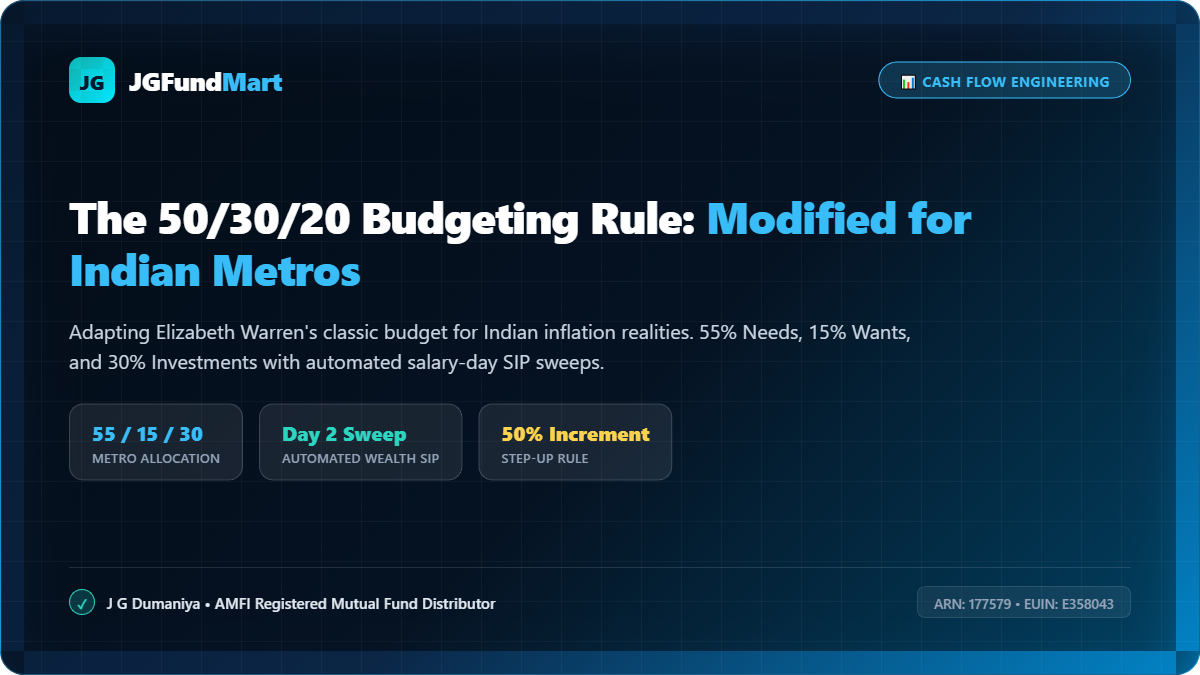
- The Calibrated Indian Urban Ratio (50 / 20 / 30 or 55 / 15 / 30): To counter 7% headline CPI and 11% to 12% lifestyle inflation, ambitious Indian wealth builders must compress lifestyle wants down to 15%–20% and supercharge investments to at least 30% of take-home pay.
- The Net Take-Home Base Rule: Always apply the 50/30/20 formula to Net Take-Home Pay (In-Hand Cash) after statutory deductions for Income Tax (TDS), Employee Provident Fund (EPF), and Professional Tax have already been deducted at source.
- The Automated 4-Account Financial Architecture: Budgeting fails when reliant on willpower. Eliminate behavioral fatigue by automating cash flows into four distinct bank accounts: Salary Receiving Hub, Fixed Overheads Account, Wealth Compounding SIP Account, and Guilt-Free Lifestyle Card.
- The 50% Increment Compounding Rule: Combat lifestyle creep by committing at least 50% of every annual salary hike or promotion bonus into automated Step-Up SIP mutual fund mandates before upgrading vehicles, gadgets, or apartment leases.
What is the 50/30/20 Budget Rule in India? The 50/30/20 budget rule is an intuitive cash flow management framework that divides your net in-hand monthly salary into three buckets: 50% for non-negotiable living needs (rent, EMIs, food, utilities, health insurance), 30% for lifestyle wants (dining, shopping, travel, entertainment), and 20% for future wealth creation (mutual fund SIPs, emergency funds, retirement). In Indian urban centers, financial planners recommend adjusting this to a 50/20/30 or 55/15/30 ratio to offset high urban housing costs and steep educational inflation.
The Psychology of Cash Flow Engineering
Personal financial success is rarely determined by how much money you earn; it is governed almost entirely by your savings rate and cash flow architecture. In India’s fast-growing urban economy, corporate professionals earning ₹1.5 Lakh to ₹3 Lakh per month frequently find themselves living paycheck to paycheck, burdened by lifestyle creep, impulse instant-commerce purchases, and high EMIs. Despite substantial gross incomes, their balance sheets remain fragile, completely vulnerable to corporate restructuring or unexpected medical events.
Budgeting is not an exercise in extreme frugality or deprivation; it is the deliberate, strategic allocation of your most scarce financial resource—your active labor income. By implementing a structured, inflation-adjusted framework like the modified 50/30/20 system, you gain complete clarity over your finances, eliminate guilt around discretionary spending, and automate your journey toward financial independence.
Deconstructing the 3 Buckets for Indian Households
To implement this framework effectively, every household rupee must be categorized without ambiguity into one of three distinct functional buckets:
Bucket 1: Essential Needs (Target: 50% to 55% of Net Income)
Core Definition: Expenses that are absolutely non-negotiable for physical survival, basic health, legal compliance, and preserving your primary income-earning ability. If you lost your job tomorrow, these bills would still need to be paid.
Indian Household Inclusions: House rent or home loan EMI, apartment maintenance charges, municipal property taxes, basic groceries and staples, cooking gas (piped/LPG cylinder), electricity bills, water supply charges, high-speed broadband, essential mobile connectivity, pure term life insurance premiums, family health insurance premiums, vehicle third-party insurance, public school or basic educational tuition for children, and ongoing prescription medicines for elderly dependents.
Bucket 2: Lifestyle Wants (Target: 15% to 20% of Net Income)
Core Definition: Discretionary choices that elevate comfort, entertainment, social connection, and lifestyle convenience, but are not mandatory for basic survival. If economic conditions deteriorate, every item in this bucket can be immediately paused without endangering your family.
Indian Household Inclusions: Weekend dining out, fast-delivery instant commerce convenience surcharges (Zomato, Swiggy, Zepto, Blinkit), premium OTT streaming subscriptions (Netflix, Prime, Disney+ Hotstar), gym and fitness club memberships, weekend staycations and annual holiday vacations, branded apparel, consumer electronics upgrades (latest iPhone or smartwatch), cinema outings, and social hosting/gifting for family weddings and festivals.
Bucket 3: Wealth Investments & Debt Liquidation (Target: 25% to 35% of Net Income)
Core Definition: Capital deployed specifically to build compounding net worth, fund future milestone goals, generate passive cash flow, and permanently eliminate expensive debt liabilities.
Indian Household Inclusions: Automated Systematic Investment Plans (SIPs) in diversified equity and hybrid mutual funds, building and maintaining the 6-month liquid emergency fund, voluntary contributions to Public Provident Fund (PPF) and National Pension System (NPS), accelerated principal prepayments against high-interest personal loans or home loans, and funding dedicated college education and retirement portfolios.
Why the Western 50/30/20 Rule Strains in Indian Urban Centers
The standard 50/30/20 template was conceptualized for the United States economy, where public healthcare safety nets (Medicare/Medicaid), subsidized state schooling, and mature mortgage markets with 30-year fixed low rates prevail. When applied uncritically to Indian metropolitan environments, the model breaks down due to four structural socioeconomic factors:
- Disproportionate Metro Real Estate Costs: In high-demand employment hubs like Mumbai (BKC, Lower Parel, Western Suburbs), Bengaluru (Whitefield, Bellandur, Sarjapur), and Gurgaon (Cyber City, Golf Course Road), apartment rentals have surged 35% to 60% over the last four years. A young couple earning ₹1.8 Lakh net often spends ₹60,000 to ₹75,000 per month on rent and society maintenance alone—consuming 33% to 42% of their entire take-home pay before buying a single grain of rice!
- The Privatized Social Infrastructure Burden: In India, quality healthcare and premier education are largely privately funded. Between private school fees (often ₹1.5 Lakh to ₹3.5 Lakh per child annually) and comprehensive family health insurance with super top-ups, mandatory survival overheads naturally push beyond 50%.
- Lifestyle Inflation & The Convenience Economy: The hyper-growth of 10-minute quick commerce (Blinkit, Zepto, Instamart) and app-based cab aggregators (Uber, Ola) has blurred the psychological boundary between Wants and Needs. Many professionals rationalize a ₹400 daily iced coffee or ₹800 convenience cab ride as a “necessity,” stealthily cannibalizing their investment capacity.
- Higher Education & Medical Inflation Realities: While the Reserve Bank of India aims for a headline CPI inflation band of 4% to 6%, specialized sectors face relentless double-digit cost inflation. Medical treatments inflate at 11% to 14% p.a., while elite Indian higher education costs (such as IIM MBA or private medical college fees) double every 6 to 7 years. Saving merely 20% is mathematically insufficient to fund both early retirement and children’s global higher education.
The Calibrated Indian Ratios: 4 Household Archetypes
To provide realistic, actionable benchmarks, JGFundMart has engineered calibrated budget ratios across four distinct Indian urban life stages:
| Household Archetype | Typical Net In-Hand Salary | Recommended Ratio (Needs / Wants / Invest) | Rupee Allocation Breakdown | Strategic Financial Focus |
|---|---|---|---|---|
| 1. Early Career Bachelor (Age 22–28) | ₹65,000 / month | 50% / 20% / 30% | Needs: ₹32,500 Wants: ₹13,000 Invest: ₹19,500 |
Aggressive equity mutual fund SIP compounding; build initial 6-month emergency buffer |
| 2. Dual-Income No Kids – DINK (Age 28–35) | ₹2,20,000 / month (Combined) | 45% / 15% / 40% | Needs: ₹99,000 Wants: ₹33,000 Invest: ₹88,000 |
Golden wealth acceleration window; amass home down payment and supercharge retirement equity |
| 3. Single-Earner Family with 2 Kids | ₹1,60,000 / month | 60% / 15% / 25% | Needs: ₹96,000 Wants: ₹24,000 Invest: ₹40,000 |
Accommodate school fees and family floater health cover; prioritize child higher education SIPs |
| 4. Peak Earning Sandwich Generation (Age 42–52) | ₹3,20,000 / month | 50% / 15% / 35% | Needs: ₹1,60,000 Wants: ₹48,000 Invest: ₹1,12,000 |
Support aging parents’ healthcare; finalize college funding; aggressively close retirement deficit |
The Automated 4-Account Banking Architecture
Manual budgeting using spreadsheets, expense-tracking apps, or daily receipt logging almost always collapses within 60 to 90 days due to cognitive friction and willpower fatigue. Institutional financial planners solve this through structural automation—designing a multi-bank architecture where cash flows are routed automatically before you have the opportunity to spend them.
Chronological Cash Flow Routing (The Salary Day Sequence):
- Account 1: The Salary Hub (Primary Bank Account): Net salary credits on the final working day or 1st of the month. Zero discretionary debit cards or UPI apps are linked to this account. It acts strictly as an automated distribution switchboard.
- Day 2 – Wealth Compounding Sweep (The “Pay Yourself First” Principle): Automated NACH standing mandates trigger immediately, sweeping 30% of salary into diversified equity/hybrid mutual fund SIPs, PPF, and emergency liquid funds. Wealth accumulation is treated as your first non-negotiable creditor.
- Day 3 – Fixed Overheads Transfer (Needs Account): An automated standing instruction transfers 50% to 55% of salary into a dedicated Bills Account. From this second account, auto-pay settles house rent, home loan EMIs, electricity, broadband, school fees, and insurance premiums.
- Day 4 – Guilt-Free Lifestyle Allowance (Wants Account): The residual 15% to 20% is swept into a digital neo-bank account or prepaid UPI wallet (e.g., Jupiter, Fi, PayTM Payments Bank). This is your family’s guilt-free spending budget for the month. You are free to dine out, watch movies, or order online without tracking individual line items. When this balance hits zero, discretionary spending halts until the next month’s credit.
Defeating Lifestyle Creep: The 50% Step-Up SIP Blueprint
As professionals progress through their careers, annual salary increments and performance bonuses create a dangerous phenomenon known as lifestyle creep. An employee promoted from ₹12 Lakh to ₹18 Lakh per annum often automatically upgrades their apartment to a luxury society, purchases an expensive SUV on 7-year auto loan EMIs, and starts frequenting fine-dining restaurants. Consequently, their savings rate remains stagnant at 10% despite a 50% increase in gross income.
The Golden 50% Increment Rule: Whenever you receive an annual salary appraisal, bonus, or job switch hike, commit to allocating at least 50% of the net post-tax increase directly into your automated Step-Up SIPs. You can freely allocate the remaining 50% to upgrade your lifestyle and celebrate your career success.
Mathematical Comparison: Flat SIP vs 10% Step-Up SIP (15-Year Horizon at 12% CAGR):
Consider an investor starting with a monthly SIP of ₹20,000 at age 30, investing in diversified equity mutual funds delivering a realistic 12% annualized return over 15 years:
| Strategy Mode | Monthly SIP Profile | Total Invested Capital | Estimated Wealth Gain | Final Maturity Corpus |
|---|---|---|---|---|
| Flat Static SIP | ₹20,000 every month for 15 years | ₹36,00,000 | ₹64,91,520 | ₹1,00,91,520 (₹1.01 Cr) |
| 10% Annual Step-Up SIP | ₹20,000 starting; increases 10% yearly | ₹76,25,385 | ₹1,04,56,874 | ₹1,80,82,259 (₹1.81 Cr) |
By simply stepping up your monthly SIP contribution by 10% each year (easily funded from your annual increment under the 50% increment rule), your final retirement corpus expands from ₹1.01 Crore to ₹1.81 Crore—generating an additional ₹79.9 Lakh of pure compounding wealth!
Financial Calculators To Calibrate Your Capital Allocation
Model your personal savings rate and simulate compounding wealth accumulation:
Frequently Asked Questions (FAQs) – 50/30/20 Budgeting in India
1. Should the 50/30/20 rule be applied to gross salary or net take-home salary?
Always apply the rule to Net Take-Home Salary (In-Hand Cash). Statutory deductions such as Income Tax (TDS), Employee Provident Fund (EPF), and Professional Tax are deducted before the money enters your bank account. Budgeting on gross CTC creates an artificial deficit because tax deductions cannot be reallocated.
2. How should credit card EMIs be classified under Needs vs Wants?
Classify the EMI based on the original underlying purchase: an EMI for a replacement work laptop is a Need, whereas an EMI for a luxury vacation or flagship smartphone is a Want. However, because credit card debt carries severe financial penalties if missed, servicing the minimum due is an operational Need, but clearing the balance belongs in the Debt Liquidation / Investment bucket.
3. What should I do if my essential Needs exceed 60% of my take-home pay?
If your Needs exceed 60%, adopt a 60 / 15 / 25 or 65 / 10 / 25 survival budget. Never sacrifice your 20% to 25% investment baseline to fund lifestyle luxuries. Compress discretionary wants (dining out, subscriptions, luxury vacations) until a salary hike or debt prepayment lowers your fixed overhead ratio.
4. Is purchasing a car considered a Need or a Want in India?
Basic, reliable transportation for family mobility or daily commuting is a Need. However, purchasing a luxury German sedan or high-end SUV with EMIs exceeding 15% of your income is a lifestyle Want. Follow the 20/4/10 Rule for auto financing: minimum 20% down payment, loan tenure capped at 4 years, and total monthly car costs (EMI + fuel + insurance) under 10% of gross pay.
5. How do freelancers, commission agents, or entrepreneurs with variable income budget?
Variable earners should budget based on their lowest monthly income over the past 12 months as their baseline. In high-earning windfall months, the surplus cash is swept directly into a “Buffer Holding Account” (liquid mutual fund). This buffer account pays you a steady, fixed “monthly salary” during low-revenue dry spells.
6. Are life and health insurance premiums classified under Needs or Investments?
Pure term life insurance and family health insurance policies are strictly Essential Needs, because they protect your family against catastrophic bankruptcy. Do not classify traditional endowment or ULIP policies as pure insurance; they are hybrid products with high fee drag that should be evaluated under investments.
7. How does the New Tax Regime (Section 115BAC) impact budgeting?
The New Tax Regime provides higher basic exemption limits (₹3 Lakh) and lower slab tax rates, increasing immediate monthly in-hand take-home cash flow for middle earners. However, because it eliminates deductions under Section 80C and 80D, investors must maintain self-discipline to invest their extra cash in mutual fund SIPs rather than spending it on lifestyle wants.
8. How do I budget for annual festive expenses like Diwali or family weddings?
Do not fund festivals or annual vacations out of that specific month’s income or credit card debt. Create a Sinking Fund: calculate your anticipated annual festive and holiday spend (e.g., ₹1,20,000/year), divide by 12 (₹10,000/month), and route that sum into an Arbitrage Fund or Recurring Deposit every month within your 15% Wants allocation.
Explore Related Personal Finance & Wealth Engineering Guides:
- Emergency Fund Architecture: How Much to Save & Where to Park Cash in India →
- Debt Avalanche vs Debt Snowball: Mathematical Strategy to Clear Loans Fast →
- How SIP Works: Compounding Wealth & Step-Up SIP Wealth Acceleration →
- Retirement Corpus Planning in India: Rule of 25 & 30 with 7% Inflation →
- FIRE Movement in India: Lean, Fat & Coast Financial Independence Blueprints →