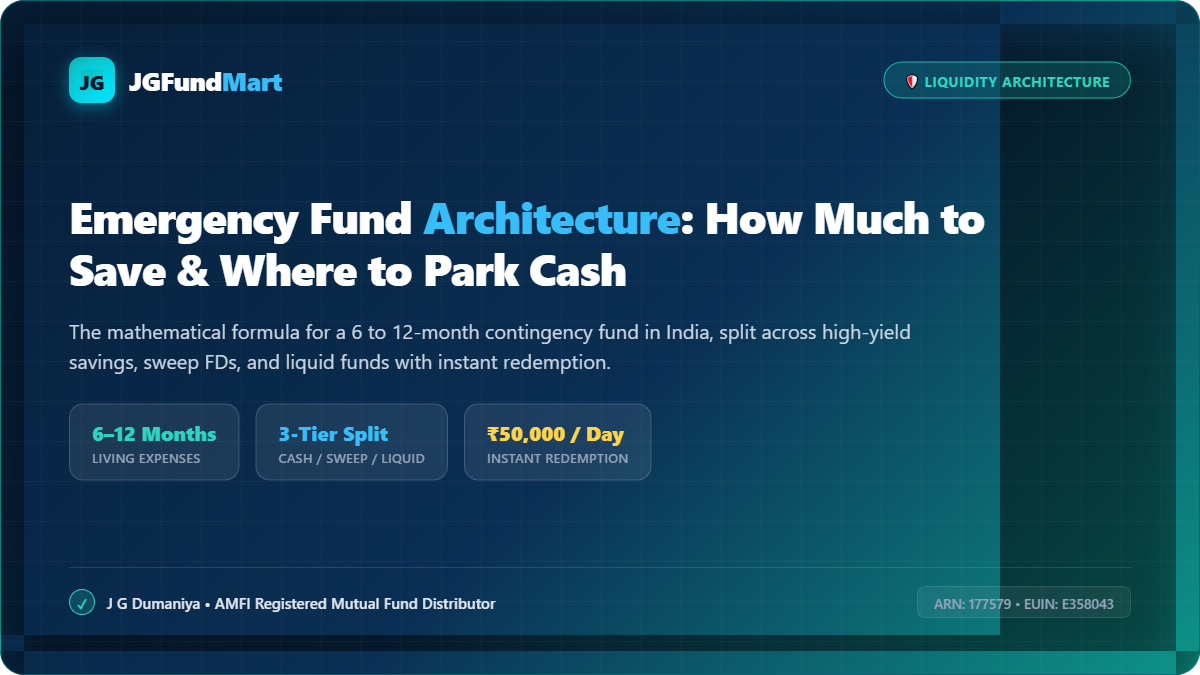
Key Takeaways & Executive Summary
- Mathematical Emergency Fund Sizing: An emergency fund must strictly cover Mandatory Living Expenses (MLE), NOT gross income. The benchmark multiplier is 6 months for dual-income salaried households with stable jobs, 9 months for single-income families, and 12 to 15 months for entrepreneurs, freelancers, commission agents, and private-sector startup employees.
- The 3-Tier Liquidity Ladder: Never park 100% of emergency reserves in a single bank account or locked fixed deposit. Deploy a synchronized three-tier structure: 20% in High-Yield Instant Savings (T+0), 40% in Auto-Sweep Flexi Fixed Deposits (T+0 instant break), and 40% in Sovereign / AAA Liquid Mutual Funds & Overnight Funds (T+1 with instant redemption).
- SEBI Instant Redemption Facility: SEBI regulations permit liquid mutual fund schemes to offer an Instant Access Facility (IAF) of up to ₹50,000 or 90% of folio value per day (whichever is lower), crediting directly to your verified bank account via IMPS within 30 seconds, 24/7/365.
- Section 50AA Debt Fund Taxation & The Arbitrage Alternative: Under Finance Act provisions (Section 50AA), debt mutual funds purchased after April 1, 2023, are taxed at your marginal income tax slab rate without indexation. For investors in the 30% to 39% tax brackets, Arbitrage Funds provide an attractive tax-efficient cash parking alternative, taxed as equity (20% STCG / 12.5% LTCG).
- DICGC ₹5 Lakh Insurance Shield: Under the Deposit Insurance and Credit Guarantee Corporation (DICGC) Act, deposits across savings accounts, recurring deposits, and fixed deposits are insured up to a maximum statutory limit of ₹5,00,000 per depositor per bank (principal plus accrued interest). Large emergency reserves must be distributed across different systemically important banks.
- The Golden Isolation Rule: Keep emergency cash in a dedicated bank account with zero linked credit cards, zero UPI apps on your primary daily smartphone, and zero auto-debits for lifestyle spending. An emergency fund must remain psychologically and operationally quarantined from discretionary consumption.
What is an Emergency Fund in India? An emergency fund is a dedicated, highly liquid cash reserve mathematically engineered to cover 6 to 12 months of non-negotiable living costs (rent, loan EMIs, food, utilities, school fees, and medical deductibles). Designed exclusively for capital preservation and immediate T+0 liquidity rather than return maximization, it shields families from distress-selling equity mutual fund investments during market crashes or falling into predatory high-APR revolving credit card debt traps.
Why Financial Plans Collapse Without a Liquidity Moat
In personal wealth management, an emergency fund functions as the concrete foundation of your entire balance sheet. Without an unshakeable liquidity moat, any unforeseen life dislocation—such as sudden medical emergencies, hospitalization deductibles, corporate downsizing, temporary career transitions, or critical automotive and home repairs—inevitably forces families into two catastrophic financial outcomes:
- Distress Liquidation of Compounding Assets: Selling equity mutual fund units or shares during an untimely stock market correction. Liquidating equity during a 20% to 30% market drawdown crystallizes temporary paper drawdowns into permanent capital destruction and resets the exponential power of compounding.
- The High-APR Debt Spiral: Swiping credit cards with annualized finance charges exceeding 42% to 48% p.a., or taking unsecured personal loans with interest rates ranging between 14% and 22% p.a. Servicing high-interest unsecured debt consumes future cash flows, locking families in an inescapable financial treadmill.
An emergency fund is not an aggressive investment designed to outpace equity indices. It is an operational insurance policy designed to protect your wealth accumulation engine from liquidation shocks.
Mathematical Sizing: Calculating Mandatory Living Expenses (MLE)
A widespread mistake made by salaried professionals in India is calculating emergency funds as a multiple of their take-home monthly salary. If you earn ₹2,00,000 per month but save and invest ₹90,000 while living comfortably on ₹1,10,000, your emergency fund should cover your actual essential survival expenses, not your gross compensation.
To compute your exact emergency number, perform an institutional audit of your household cash outflows, separating them into Mandatory Living Expenses (MLE) and Discretionary Lifestyle Outflows (DLO):
| Expense Category | Line Items & Sub-Heads Included | Emergency Status | Calculation Weight |
|---|---|---|---|
| Housing & Shelter | Home loan EMI, apartment rent, society maintenance charges, municipal property taxes | Non-Negotiable | 100% Inclusion |
| Basic Subsistence & Utilities | Groceries, cooking gas (LPG/piped), electricity bills, water, broadband, essential mobile recharges | Non-Negotiable | 100% Inclusion |
| Essential Insurance Protection | Pure term life insurance premiums, family floater health insurance premiums, motor third-party cover | Non-Negotiable | 100% (Monthly Prorated) |
| Family & Dependent Commitments | School/college tuition fees, dependent parents’ regular prescription medicines, senior citizen support | Non-Negotiable | 100% Inclusion |
| Mandatory Debt Servicing | Car loan EMIs, education loan EMIs (excluding credit card balances which should be zeroed) | Non-Negotiable | 100% Inclusion |
| Discretionary Lifestyle Spending | Dining out, food delivery apps (Zomato/Swiggy), OTT streaming bundles, luxury apparel, vacations | Discretionary | 0% (Completely Excluded) |
The Contingency Multiplier Formula
Once you aggregate your total Monthly Mandatory Living Expenses (MLE), determine your specific Contingency Multiplier (N) based on household income diversity and employment volatility:
The Core Sizing Equation:
Target Emergency Corpus = [Monthly Mandatory Living Expenses (MLE) × Multiplier (N)] + Standalone Medical Deductible Buffer
- N = 6 Months: Dual-income households where both spouses earn stable salaried income in established MNCs, government services, or public sector undertakings (PSUs), with no heavy debt obligations.
- N = 9 Months: Single-income households where one breadwinner supports dependent children and senior citizen parents, or professionals working in cyclical industries (IT consulting, media, real estate, manufacturing).
- N = 12 to 15 Months: Entrepreneurs, small business owners, commissioned sales agents, freelancers, doctors with private clinics, and employees of early-stage venture-funded startups where compensation includes volatile ESOPs and funding cycles fluctuate.
- The Medical Deductible Buffer: Always add a standalone cash buffer of ₹50,000 to ₹1,00,000 to absorb hospital admission deposits, non-medical consumables (syringes, PPE kits, administrative surcharges), and health insurance policy co-payments that insurance policies legally exclude.
The 3-Tier Liquidity Ladder: Balancing Instant Access and Yield
Leaving your entire ₹10 Lakh emergency corpus parked in a standard bank savings account earning a meager 2.70% to 3.00% interest guarantees purchasing power destruction against 6% to 7% inflation. Conversely, locking the entire sum into multi-year fixed deposits exposes you to premature withdrawal penalties and broken interest rates during emergencies.
The optimal institutional strategy is deploying a synchronized 3-Tier Liquidity Ladder across different banking and financial instruments:
Tier 1: Instant Cash Shield – T+0 Real-Time Access (20% of Corpus)
Target Vehicle: High-yield savings accounts or sweep-in accounts in Domestic Systemically Important Banks (D-SIBs) like State Bank of India (SBI), HDFC Bank, or ICICI Bank.
Operational Objective: Instant, zero-friction liquidity available 24/7/365 via ATM cash withdrawal, debit card POS swipes, or UPI/IMPS transfers. If a midnight hospital admission requires an immediate ₹30,000 cash deposit or an urgent home plumbing burst demands ₹10,000, Tier 1 fulfills the requirement within 60 seconds without breaking investments.
Tier 2: Near-Term Liquidity – Auto-Sweep Flexi Fixed Deposits (40% of Corpus)
Target Vehicle: Multi-Option Deposit Schemes (MODS) or Auto-Sweep Fixed Deposits linked directly to your core savings account.
Operational Objective: Earn prevailing 1-year FD interest rates (typically 6.50% to 7.25% p.a.). If an emergency withdrawal exceeds your Tier 1 savings balance, the bank’s core banking system automatically sweeps and breaks the exact required amount in units of ₹1,000 without penalty on the remaining unbroken FD corpus, settling funds instantaneously.
Tier 3: Strategic Cash Preservation – Liquid & Overnight Mutual Funds (40% of Corpus)
Target Vehicle: SEBI-regulated Liquid Mutual Funds and Overnight Mutual Funds with top-tier sovereign and AAA paper portfolios (e.g., Treasury Bills, Tri-Party Repos / TREPS, Certificates of Deposit).
Operational Objective: Provides complete insulation from equity market drawdowns and interest rate fluctuations, offering predictable yields (6.40% to 6.85% p.a.). Under SEBI circulars, Tier 3 liquid funds offer an Instant Access Facility (IAF) allowing you to redeem up to ₹50,000 or 90% of your folio value per day within 30 seconds via IMPS, while larger redemptions execute on a T+1 business day turnaround.
Comprehensive Comparison: Where to Park Emergency Cash in India
| Parking Instrument | Expected Annual Yield | Liquidity Turnaround | Credit / Capital Risk | Taxation Treatment | Suitability Rating |
|---|---|---|---|---|---|
| Regular Savings Account | 2.70% – 3.00% p.a. | Real-time Instant (T+0) | Zero (DICGC insured up to ₹5L) | Taxed at slab rate; ₹10k deduction under 80TTA | High (Tier 1 only) |
| Auto-Sweep Flexi FD | 6.50% – 7.25% p.a. | Instant auto-break via net banking | Zero (DICGC insured up to ₹5L) | TDS deducted above ₹40k (₹50k seniors); taxed at slab | Very High (Tier 2) |
| Liquid Mutual Funds | 6.40% – 6.90% p.a. | ₹50k/day instant; balance T+1 business day | Negligible (portfolio maturity ≤ 91 days) | Taxed at marginal slab rate under Section 50AA | Very High (Tier 3) |
| Arbitrage Funds | 6.75% – 7.50% p.a. | T+1 business day (exit load if < 15–30 days) | Very Low (hedged cash-futures arbitrage) | Equity Tax: 20% STCG / 12.5% LTCG (> ₹1.25L) | High (for 30%+ slab) |
| Short-Term Debt Funds | 7.00% – 7.50% p.a. | T+1 business day (exit load possible) | Moderate (exposed to 1–3 yr duration risk) | Taxed at marginal slab rate under Section 50AA | Unsuitable (duration risk) |
| Equity / Balanced Hybrid Funds | Volatile (-15% to +25%) | T+2 business days | Severe Market Drawdown Risk | 20% STCG / 12.5% LTCG | Strictly Prohibited |
The Arbitrage Fund Play: Tax Alpha for 30% and 39% Tax Brackets
Following the Finance Act 2023 amendment which introduced Section 50AA to the Income Tax Act, mutual fund schemes investing less than 35% in domestic equity shares lost their indexation benefits and long-term tax status. Consequently, all gains from liquid funds, ultra-short debt funds, and bank fixed deposits are lumped into your gross income and taxed at your marginal slab rate.
The High-Earner Tax Dilemma: An investor falling in the highest 30% tax bracket plus surcharge and cess (effective 39.00% tax rate) who earns 7.00% p.a. on a Fixed Deposit or Liquid Fund is left with an effective post-tax yield of only 4.27% p.a., severely lagging real inflation.
The Arbitrage Fund Solution: Arbitrage funds eliminate market directional risk by simultaneously buying shares in the cash market and selling equivalent stock futures contracts, locking in the spread. Because they maintain over 65% gross equity exposure, they are classified as Equity Oriented Funds under Section 112A and 111A:
- Short-Term Gains (≤ 12 Months): Taxed at a flat 20% (effective 20.80% with cess) instead of 39%!
- Long-Term Gains (> 12 Months): Taxed at 12.5% on gains exceeding the ₹1.25 Lakh annual exemption!
- Effective Net Yield: A 7.00% return in an Arbitrage Fund held for over 1 year yields an effective post-tax return of approximately 6.12% p.a., delivering a massive 185 basis points of pure tax alpha over fixed deposits!
Understanding the DICGC ₹5 Lakh Insurance Shield
Many investors believe that all funds parked in scheduled commercial banks are 100% guaranteed by the Government of India. In reality, bank deposits are governed by the Deposit Insurance and Credit Guarantee Corporation (DICGC), a wholly-owned subsidiary of the Reserve Bank of India (RBI):
- Statutory Coverage Limit: DICGC insures each depositor up to a maximum of ₹5,00,000 (Five Lakh Rupees) for both principal and interest amounts held in the same capacity and same right across all branches of a single bank.
- Aggregation Across Accounts: If you hold a savings account with ₹3,00,000 and a fixed deposit of ₹4,00,000 in the same bank (total ₹7,00,000), only ₹5,00,000 is legally protected if that bank is placed under RBI moratorium or liquidation. The remaining ₹2,00,000 is exposed to resolution haircuts.
- How to Legally Expand DICGC Protection: You can achieve complete statutory protection for larger emergency reserves (e.g., ₹20 Lakhs to ₹30 Lakhs) by distributing cash across:
- Different institutional banking groups (e.g., ₹5 Lakh in SBI, ₹5 Lakh in HDFC Bank, ₹5 Lakh in ICICI Bank).
- Different ownership capacities within the same bank: An individual account (Capacity A) and a joint account with your spouse in ‘Either or Survivor’ mode (Capacity B) are treated as two distinct legal capacities, each carrying independent ₹5 Lakh DICGC insurance coverage.
5 Catastrophic Mistakes That Destroy Emergency Funds
- Chasing Speculative Returns: Moving emergency reserves into mid-cap funds, crypto, or peer-to-peer (P2P) lending platforms chasing 12% to 15% returns. An emergency fund is designed for liquidity and principal safety, not aggressive return generation.
- Treating Credit Cards as an Emergency Reserve: Believing that a ₹5 Lakh credit card limit eliminates the need for an emergency fund. In a severe macro recession, banks routinely cut unsecured credit lines without notice. Furthermore, emergency cash needs (such as bail bonds, contractor payments, or private school fees) cannot be settled via credit cards without exorbitant cash-advance fees.
- Locking Funds in Long-Term Instruments: Parking emergency capital in Public Provident Fund (PPF – 15-year lock-in) or traditional endowment life insurance plans. While capital is safe, withdrawal restrictions defeat the core purpose of instant crisis response.
- Failing to Index for Inflation: Setting aside ₹3 Lakhs in 2020 and leaving it unchanged in 2026. With healthcare inflation running at 11% and metro living costs inflating at 7% p.a., an emergency fund must be recalculated and replenished annually.
- Co-Mingling Funds with Everyday Spend: Keeping emergency money in your primary salary account with an active debit card in your wallet and UPI linked to Swiggy, Amazon, and Blinkit. Frictionless payment gateways gradually bleed the emergency cushion into discretionary lifestyle creep.
Financial Calculators To Calibrate Your Capital Allocation
Calculate your exact personalized emergency liquidity number and model compounding wealth:
Frequently Asked Questions (FAQs) – Emergency Fund Management
1. Should I stop my monthly mutual fund SIPs to build an emergency fund?
If you have zero emergency buffer, temporarily pause or scale down your equity SIPs by 50% to build an initial 3-month survival cushion as rapidly as possible. Once you achieve a 3-month buffer, resume your equity SIPs and allocate surplus monthly cash flow to steadily build the remaining 3 to 6 months of contingency reserves.
2. How does the Instant Redemption feature in Liquid Mutual Funds work?
Under SEBI regulations, leading AMCs offer an Instant Access Facility (IAF) on Liquid Funds. Investors can redeem up to ₹50,000 or 90% of their folio value per day (whichever is lower), with the funds hitting their registered bank account via IMPS within 30 to 60 seconds, 24/7 including Sundays and bank holidays.
3. Are Liquid Mutual Funds 100% safe from defaults and capital losses?
Liquid funds are strictly regulated by SEBI: they can only invest in debt and money market instruments with a residual maturity of up to 91 days, and must hold at least 20% in sovereign cash, T-bills, and repos. To ensure absolute safety, select top-tier liquid funds with over 85% sovereign/AAA allocations and multi-thousand crore AUMs.
4. Is physical gold or Digital Gold suitable as an emergency fund?
No! Physical gold jewelry incurs significant making charge deductions (10% to 20%) and melting loss haircuts during distress pawn sales. Digital gold carries a 3% GST deduction on purchase and wide bid-ask spreads (2% to 4%). Furthermore, gold prices are subject to global cyclical drawdowns. Emergency cash must remain non-volatile.
5. How does a Home Loan Overdraft (Maxgain) function as an emergency fund?
A Home Loan Overdraft account allows borrowers to park surplus cash in an account linked to their home loan. The parked cash offsets principal balance, reducing daily interest at 8.5% to 9.0% p.a. completely tax-free, while remaining withdrawable via net banking at any time. This is an exceptional, highly efficient parking vehicle for homeowners.
6. How often should an emergency fund be reviewed and updated?
Conduct an emergency fund audit once every 12 months, or immediately following major life events: purchasing a home with new EMIs, welcoming a child, an elderly parent moving in, or receiving a major promotion that expands mandatory living costs.
7. What should be done immediately after tapping into the emergency fund?
Once the crisis has passed, rebuilding your emergency reserve takes first priority over discretionary spending or additional investments. Divert all non-essential savings until the 3-Tier Liquidity Ladder is restored to its 100% target baseline.
8. How is interest on Sweep-in Fixed Deposits taxed in India?
Interest earned on sweep-in FDs is added to your total income and taxed at your marginal income slab rate. Banks deduct 10% TDS under Section 194A if total FD interest across all branches exceeds ₹40,000 per financial year (₹50,000 for senior citizens).
Explore Related Personal Finance & Liquidity Masterclasses:
- The 50/30/20 Budgeting Rule Modified for Indian Inflation: Execution Guide →
- Debt Avalanche vs Debt Snowball: Mathematical Strategy to Clear Loans Fast →
- How SIP Works: The Power of Compounding & Step-Up SIP Wealth Creation →
- Systematic Transfer Plan (STP): Parking Liquid Cash to Stagger Equity Inflows →
- Health Insurance & Mediclaim: How to Structure Comprehensive ₹1 Crore Cover →