Key Takeaways & Executive Summary
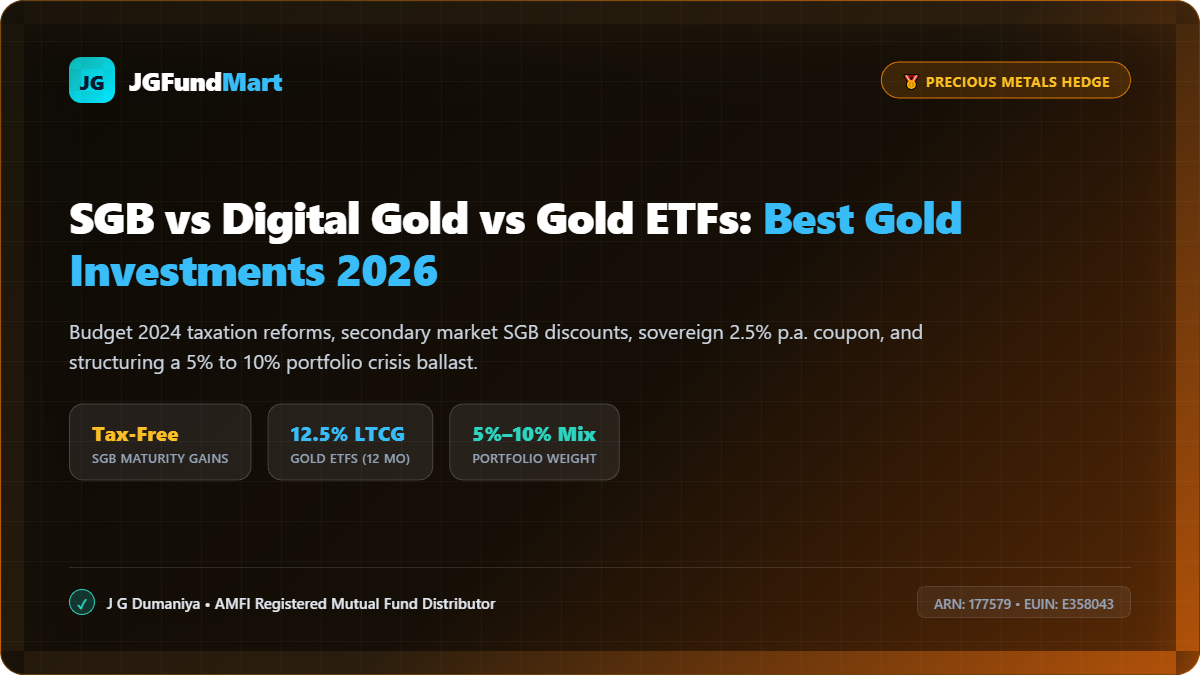
- Union Budget 2024 Regulatory Realignment: The Government of India slashed gold customs import duty from 15% to 6%, curbing domestic smuggling while realigning tax rules. Under the Finance Act 2024, the holding period for Long-Term Capital Gains (LTCG) on Gold ETFs and Gold Mutual Funds was shortened to 12 months, taxed at a flat rate of 12.50% without indexation.
- The SGB Sovereign Supremacy: Sovereign Gold Bonds (SGBs) issued by the Reserve Bank of India (RBI) remain the undisputed gold standard for long-term investors: 100% tax-free capital gains on 8-year maturity redemption under Section 47(viic) of the Income Tax Act, plus a guaranteed 2.50% p.a. simple interest credited semi-annually.
- The Secondary Market SGB Discount Alpha: While the Government has reduced new primary SGB issuances, over 60 active SGB tranches trade on the NSE and BSE. Savvy investors can purchase secondary market SGBs at 3% to 7% discounts to prevailing spot gold prices, locking in higher Yields to Maturity (YTM) and tax-free redemptions.
- The Digital Gold Pitfall: “Digital Gold” sold by fintech apps is completely unregulated by SEBI or RBI. It inflicts an immediate 6% to 8% friction loss upon purchase due to non-refundable 3% GST and aggressive 3% to 5% bid-ask platform spreads, accompanied by mandatory 5-year storage limits.
- Physical Jewelry Inefficiencies: Buying physical gold jewelry for investment incurs 12% to 25% non-recoverable making charges, 3% GST, purity uncertainty, and recurring bank locker rental fees. Jewelry should be treated as personal emotional consumption, never as an investment asset.
- Optimal Portfolio Allocation: Prudent multi-asset allocation frameworks dictate allocating strictly 5% to 10% of total liquid net worth to paper/electronic gold as an inflation hedge and geopolitical crisis ballast.
What is the Best Way to Invest in Gold in India? For long-term investors with an investment horizon of 5 to 8 years, Sovereign Gold Bonds (SGB) are mathematically the superior choice, delivering 100% tax-free capital gains at maturity plus 2.50% annual interest. For investors seeking high liquidity, systematic monthly SIPs, or horizons under 5 years, Gold ETFs (and Gold Mutual Funds) offer the best vehicle, with low expense ratios (0.25%–0.50%), real-time stock exchange liquidity, and a 12-month LTCG tax rate of 12.5% under Budget 2024 rules.
The Macro Role of Gold in an Indian Wealth Architecture
In Indian culture, gold occupies a sacred emotional and ceremonial position. For centuries, Indian families have viewed physical gold as the ultimate store of generational value and a crisis buffer. From an institutional wealth management perspective, gold serves a vital mathematical function in a multi-asset portfolio: it acts as a non-correlated asset class that hedges against currency depreciation, geopolitical conflict, and systemic stagflation.
Historically, domestic gold prices in Indian Rupees (INR) have delivered an annualized return of approximately 10.2% to 10.8% CAGR over the past 25 years. This return is driven by two distinct engines: (1) global spot gold price appreciation in US Dollars, and (2) the steady long-term structural depreciation of the Indian Rupee against the US Dollar (historically ~3.0% to 3.5% p.a.). However, while holding gold is essential for risk diversification, how you own gold dictates whether you compound wealth or forfeit your returns to making charges, spreads, and taxes.
The 5 Vehicles for Owning Gold in India Compared
Today’s investor can choose from five distinct mechanisms to gain exposure to gold, ranging from traditional physical bars to sophisticated digital sovereign securities:
| Evaluation Parameter | Sovereign Gold Bonds (SGB) | Gold ETFs | Gold Mutual Funds (FoF) | Digital Gold (Fintechs) | Physical Jewelry |
|---|---|---|---|---|---|
| Governing Regulator | Reserve Bank of India (RBI) | SEBI | SEBI | Unregulated (Private) | Bureau of Indian Standards (BIS) |
| Underlying Purity | 999 Purity benchmarked | 995+ LBMA audited bullion | Invests directly in Gold ETFs | 999 Purity (private vault) | Variable (22K / 18K Hallmarked) |
| Additional Yield | +2.50% p.a. cash interest | 0.00% | 0.00% | 0.00% | Negative (Locker fees) |
| Entry Friction / GST | 0% GST, Zero making charges | 0% GST, 0.25%–0.50% TER | 0% GST, 0.50%–0.80% TER | 3% GST + 3% to 5% spread | 3% GST + 12% to 25% Making |
| Liquidity & Settlement | T+1 on stock exchanges; RBI at Yr 5 | Instant intraday market trades | T+1 AMC redemptions | App liquidation at dealer bid | Physical jeweller visit + melting haircut |
| Capital Gains Tax | 100% TAX-FREE at maturity | 12.5% LTCG after 12 mos | 12.5% LTCG after 12 mos | 12.5% LTCG after 24 mos | 12.5% LTCG after 24 mos |
Sovereign Gold Bonds (SGB): The Undisputed Sovereign Champion
Launched by the Government of India in November 2015 under the Sovereign Gold Bond Scheme, SGBs represent government debt denominated in grams of gold. They are issued by the Reserve Bank of India on behalf of the Government of India, carrying the highest sovereign credit rating.
The Unrivaled Benefits of Sovereign Gold Bonds:
- Section 47(viic) Tax Exemption: Under Section 47(viic) of the Income Tax Act, any capital gains arising to an individual upon the redemption of an SGB with the Reserve Bank of India (at the end of 8 years, or at the early redemption windows at years 5, 6, and 7) are 100% EXEMPT FROM CAPITAL GAINS TAX. Whether gold doubles, triples, or quadruples over the 8-year tenure, you pay zero tax!
- Guaranteed 2.50% p.a. Cash Interest: The Government pays a simple interest of 2.50% per annum on your original nominal subscription price. This interest is credited directly to your registered bank account every six months (in May and November, depending on the tranche). Note: This 2.5% interest is taxable at your marginal income slab rate under “Income from Other Sources.”
- Zero Storage & Zero Custody Drag: SGBs sit securely in your Demat account (or in an RBI Certificate of Holding). There are zero locker charges, zero management fees, zero insurance premiums, and zero expense ratios.
The Pro Investor Play: Buying SGBs at a Discount on the Stock Exchange
Because the Ministry of Finance has scaled back primary public issuances of new SGB tranches, many retail investors believe they can no longer invest in SGBs. This is completely false. Over 60 historical SGB tranches trade daily on the National Stock Exchange (NSE) and Bombay Stock Exchange (BSE).
- Why Secondary Tranches Trade at a Discount: Retail liquidity on exchange trading books for SGBs is relatively thin. When individual holders require urgent liquidity, they place market sell orders, depressing the market price 3% to 7% below the live spot price of physical gold.
- How to Execute: Search your broker’s trading terminal for active SGB symbols (e.g.,
SGBNOV29,SGBMAR32,SGBDEC31). Compare the traded price against the live India Bullion and Jewellers Association (IBJA) gold rate. Buying a tranche trading at a 5% discount locks in immediate alpha. When the RBI redeems that series at maturity, you receive 100% of the official 3-day average IBJA closing gold price—completely tax-free!
Gold ETFs & Gold Mutual Funds: The Post-Budget 2024 Renaissance
For investors who require instant liquidity, manage systematic monthly SIPs, or maintain tactical trading horizons under five years, Gold Exchange Traded Funds (ETFs) are the most practical vehicle. Each unit of a Gold ETF listed on the NSE and BSE represents physical gold of 99.5% purity (typically 0.01 gram or 1 gram per unit) stored in high-security, insured bank vaults and audited quarterly by independent statutory auditors.
The Budget 2024 Tax Gamechanger for Gold ETFs:
Prior to July 2024, under Finance Act 2023, Gold ETFs were classified alongside debt funds under Section 50AA, subjecting all gains to marginal slab rates (up to 39%). In the Union Budget 2024, the Central Government restored equity-like holding horizons for specified financial assets:
- Holding Period Cut to 12 Months: Gold ETFs held for more than 12 months qualify for Long-Term Capital Gains (LTCG) status (down from 36 months previously).
- Flat 12.5% Tax Rate: LTCG is taxed at a flat rate of 12.50% without indexation (plus applicable surcharge and 4% cess).
- Short-Term Gains (≤ 12 Months): Taxed at your applicable marginal income tax slab rate.
Gold ETFs vs Gold Mutual Funds (Fund of Funds – FoF):
If you have an active Demat and trading account, buy Gold ETFs directly on the exchange to enjoy lower expense ratios (0.25% to 0.45% p.a.). If you do not have a Demat account or wish to run an automated monthly SIP via bank auto-debit (NACH mandate), invest in a Gold Mutual Fund (Fund of Funds). The Gold FoF collects your SIP amount and automatically invests it in underlying Gold ETF units at end-of-day NAV, with an incremental expense ratio of roughly 0.15% to 0.30% p.a.
Unmasking Digital Gold: The Retail Fintech Trap
Over the past four years, fintech wallet apps, payment gateways, and jewelry tech startups have heavily marketed “Digital Gold” with catchphrases like “Start investing in 24K gold with just ₹1.” While seamless from a user-experience standpoint, digital gold is fundamentally flawed for serious investors:
- Complete Absence of Regulatory Oversight: Digital gold is NOT a financial security regulated by SEBI, nor is it a sovereign instrument backed by the RBI. In fact, SEBI specifically issued a directive prohibiting SEBI-registered stockbrokers and investment advisers from distributing digital gold due to lack of investor protection safeguards.
- The Lethal 6% to 8% Immediate Friction Drag: When you purchase digital gold, your transaction is subject to a non-recoverable 3.00% Goods and Services Tax (GST). Furthermore, private refiners enforce a wide bid-ask spread of 3.0% to 5.0% between their buy price and sell price. If you buy ₹1,00,000 of digital gold and decide to sell it 10 minutes later, you receive only around ₹93,000 back into your bank account!
- Mandatory Storage Expiry Clauses: Private vault operators (Augmont, MMTC-PAMP, SafeGold) generally hold digital gold free of charge for only 5 to 7 years. After this holding period, you are legally compelled to either sell your holdings at the platform’s prevailing bid price or pay exorbitant physical minting, packaging, and insured courier delivery charges to convert it into physical coins.
Financial Calculators To Calibrate Your Capital Allocation
Model capital gains taxation on gold assets and simulate disciplined multi-asset wealth compounding:
Frequently Asked Questions (FAQs) – Gold Investment in India
1. Will the Indian Government issue fresh tranches of Sovereign Gold Bonds?
The Ministry of Finance has significantly curtailed new primary SGB issuances following customs duty cuts, as issuing gold-denominated sovereign debt with high domestic appreciation creates substantial fiscal liabilities for the exchequer. However, investors can freely purchase existing active SGB series on the secondary market via NSE and BSE.
2. If I buy an SGB from the stock exchange, do I still get tax-free maturity?
Yes! Under Section 47(viic) of the Income Tax Act, capital gains tax exemption applies to redemption of Sovereign Gold Bonds by an individual. As long as you hold the bond until the official 8-year maturity date (or redeem via RBI’s early redemption window after year 5) and submit it for redemption to the RBI, the entire capital gain is 100% tax-free, regardless of whether you bought it in the initial primary issue or secondary market!
3. Are Gold ETFs safer than physical gold stored at home?
Yes. Physical gold stored at home carries burglary, theft, and accidental loss risks, while bank lockers incur recurring annual rental charges and carry limited bank liability. Gold ETFs hold physical bullion of 99.5% purity in institutional, bomb-proof, insured vaults managed by custodian banks and regulated by SEBI, completely eliminating physical custody risk.
4. How do I start a monthly Gold SIP without a Demat account?
You can invest in a Gold Mutual Fund (Fund of Funds) through any mutual fund distributor or AMC portal. You do not need a Demat account; simply complete a standard mutual fund KYC and register a monthly SIP (starting as low as ₹500/month) via bank auto-debit.
5. Can Sovereign Gold Bonds be used as collateral for bank loans?
Yes! Under RBI guidelines, SGBs are officially recognized as eligible collateral for loans against securities (LAS). Commercial banks and NBFCs accept Demat SGBs as collateral, applying loan-to-value (LTV) ratios comparable to regular physical gold loans.
6. What happens if gold prices crash on the SGB redemption date?
SGB redemption value is linked strictly to the market price of gold. If gold prices decline over the 8-year tenure, the investor absorbs the price risk in gram terms. However, you still retain all accumulated semi-annual 2.50% interest payouts received across the 8-year holding period.
7. How is physical gold jewelry taxed when sold or exchanged?
Selling physical gold jewelry held for more than 24 months attracts Long-Term Capital Gains (LTCG) tax of 12.5% without indexation under Finance Act 2024. Exchanging old gold jewelry for new jewelry is legally treated as a transfer and attracts capital gains tax on the difference between sale value and original purchase cost, plus 3% GST on new making charges.
8. What percentage of an overall investment portfolio should be allocated to gold?
Institutional asset allocators recommend allocating 5% to 10% of total liquid net worth to paper gold. Allocating over 15% to gold drags down portfolio compounding because gold produces no cash flows, dividends, or industrial earnings growth, unlike equities.
Explore Related Precious Metals & Asset Allocation Guides:
- Asset Allocation Strategies: Age-Based vs Goal-Based Portfolio Rebalancing in India →
- How to Build a Balanced Mutual Fund Portfolio: Asset Allocation Roadmap →
- Mutual Fund Taxation in India: Complete Guide to Equity, Debt & Capital Gains →
- Emergency Fund Architecture: Sizing & Parking Cash Reserves in India →
- Retirement Corpus Planning in India: Rule of 25 & 30 with 7% Inflation →