Key Takeaways & Executive Summary
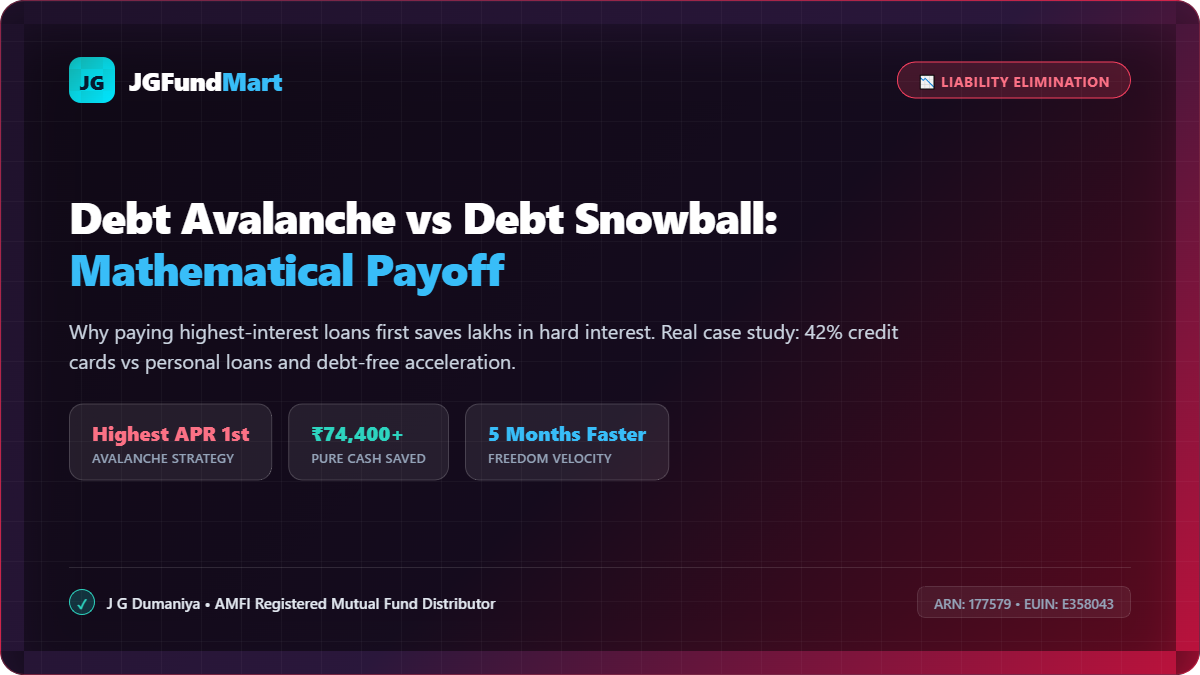
- Debt Avalanche (Mathematical Optimization): Prioritizes paying off loans in descending order of Annual Percentage Rate (APR), attacking highest-interest liabilities first. It minimizes cumulative interest outgo and frees the borrower in the shortest mathematical timeframe.
- Debt Snowball (Behavioral Momentum): Prioritizes paying off loans in ascending order of Outstanding Principal Balance, knocking out the smallest loans first regardless of interest rates. It delivers rapid psychological victories that sustain long-term repayment discipline.
- The Cost of Behavior: Across a typical multi-loan Indian household carrying ₹6 Lakh to ₹10 Lakh in unsecured liabilities, choosing Debt Snowball over Debt Avalanche typically incurs an extra ₹50,000 to ₹1,50,000 in excess interest payments to financial institutions.
- The JGFundMart Hybrid Protocol: Deploy a two-phase attack: Avalanche toxic high-APR liabilities (revolving credit card balances at 42% p.a. and fintech instant loans at 24%–36% p.a.) first, then switch to Snowball for mid-tier loans (personal loans and two-wheelers) to harvest behavioral momentum.
- The Minimum Amount Due (MAD) Trap: Paying only the 5% Minimum Amount Due on Indian credit cards locks borrowers into a 15-to-25-year debt treadmill where compound interest doubles your original purchase balance every 20 months.
- RBI Zero Foreclosure Penalty Shield: Under Reserve Bank of India (RBI) directives, banks and Non-Banking Financial Companies (NBFCs) are legally prohibited from charging foreclosure or prepayment penalties on all floating-rate term loans granted to individual borrowers.
What is the Difference Between Debt Avalanche and Debt Snowball? Debt Avalanche is a debt payoff strategy where you pay minimum dues on all loans and channel all surplus funds into the loan with the highest interest rate (e.g., 42% credit cards), saving the maximum total interest. Debt Snowball is a behavioral payoff strategy where surplus funds target the loan with the smallest balance (e.g., ₹25,000 two-wheeler loan), providing quick psychological wins by reducing the total number of open loan accounts rapidly.
The Crushing Weight of Modern Consumer Debt in India
Over the past five years, the retail lending landscape in India has undergone an aggressive digital transformation. With one-click pre-approved personal loans on banking apps, Buy Now Pay Later (BNPL) checkout integrations, and instant credit card limits, consumer borrowing has reached unprecedented levels. While debt is easily acquired in seconds, the financial friction of servicing multiple high-APR liabilities creates immense psychological stress and drains household wealth.
When an individual juggles four or five concurrent debts—two credit cards, an instant fintech personal loan, a two-wheeler EMI, and an education loan—discretionary cash flow collapses. Financial freedom requires a ruthless, structured liquidation framework. Borrowers face a fundamental choice between two time-tested strategies: The Debt Avalanche (pure mathematical optimization) and The Debt Snowball (behavioral psychological acceleration).
The Mathematical Poison: The Credit Card “Minimum Amount Due” Trap
Before selecting a payoff methodology, every Indian borrower must understand the lethal compounding mathematics behind credit card debt. Indian credit cards levy finance charges ranging from 3.4% to 3.75% per month, translating into an effective annualized rate of 42% to 48% p.a. plus 18% GST on all interest charges.
The Anatomy of the 5% Minimum Due Trap:
When your credit card statement arrives with a total due of ₹1,00,000, the bank prominently highlights the Minimum Amount Due (MAD) of ₹5,000 (5%). Many cardholders assume that paying this ₹5,000 maintains their credit standing without penalty. In reality:
- The remaining ₹95,000 unpaid balance continues to accrue interest at 42% annualized from the exact transaction date (interest-free grace period is completely revoked).
- GST of 18% is levied on the accrued interest charges, adding statutory friction to your balance.
- If an individual owes ₹1,00,000 at 42% p.a. and pays only the statutory 5% minimum due every month without making any new purchases, it will take over 18 years to clear the card, and the borrower will pay over ₹2,45,000 in pure interest on an original ₹1,00,000 balance!
The Two Titans of Debt Elimination Compared
| Evaluation Parameter | The Debt Avalanche Method | The Debt Snowball Method |
|---|---|---|
| Core Philosophy | Strict Mathematical Optimization (Interest Minimization) | Behavioral Psychology & Momentum (Quick Wins) |
| Target Sorting Metric | Highest Interest Rate (APR %) first | Lowest Outstanding Balance (₹) first |
| Cumulative Interest Cost | Absolute lowest possible interest outgo | Higher total interest (ignoring high APR loans) |
| Time to Total Debt Freedom | Fastest possible payoff timeline | Marginally longer due to compound interest drag |
| First Loan Clearance Speed | Can take many months if highest APR loan is large | Extremely rapid (often within 30 to 60 days) |
| Psychological Profile | Analytical, disciplined, motivated by spreadsheets | Anxious, overwhelmed by numerous creditors and calls |
| Greatest Risk | Motivation fatigue if Loan #1 takes 18 months to clear | Expensive debt ballooning while paying small cheap loans |
Method 1: The Debt Avalanche (Mathematical Superiority)
The Debt Avalanche is the mathematically optimal debt elimination strategy. It operates on a single immutable truth: the faster you eliminate your highest interest rate liabilities, the less total money you forfeit to financial institutions.
The 4-Step Avalanche Execution Protocol:
- Step 1 – Comprehensive Liability Audit: List every single debt account along with its current outstanding principal balance, minimum monthly EMI, and effective Annual Percentage Rate (APR). Sort this master ledger in strict descending order of APR (from highest interest rate to lowest).
- Step 2 – Minimum Payment Defense: Pay the exact minimum required payment or EMI on every single loan account to preserve credit bureau reporting, avoid late payment penalties, and prevent loan default tags on CIBIL.
- Step 3 – Concentrated Attack on Target #1: Direct 100% of your remaining surplus cash flow (from your budget’s Debt Liquidation bucket) into Loan #1 (the highest APR debt) as an accelerated principal prepayment.
- Step 4 – The Avalanche Roll-Over: When Loan #1 is completely paid off, take its entire minimum monthly payment plus your original surplus cash flow, and redirect the entire combined sum toward Loan #2. As each loan is liquidated, the cash firepower rolls down like an unstoppable avalanche.
Method 2: The Debt Snowball (Behavioral & Emotional Victory)
Popularized globally by personal finance author Dave Ramsey, the Debt Snowball recognizes that personal finance is 80% behavior and only 20% head knowledge. If human beings acted as purely rational mathematical calculators, they would never carry revolving credit card debt at 42% interest in the first place.
The 4-Step Snowball Execution Protocol:
- Step 1 – Balance Sizing Audit: List all outstanding loan balances in strict ascending order of Current Principal Balance (₹), from smallest to largest. Completely ignore interest rates!
- Step 2 – Maintain Minimum Dues: Continue servicing the minimum monthly EMI on all accounts to protect your CIBIL score.
- Step 3 – Annihilate the Smallest Debt First: Throw every surplus rupee at Loan #1 (the smallest balance). Clearing a ₹25,000 loan within two months provides an immense emotional surge, permanently removes one creditor, and proves that you can win against debt.
- Step 4 – Snowballing the Momentum: Roll the freed-up EMI of the cleared loan into the next smallest balance. As account after account is closed, the psychological sense of triumph builds unbreakable momentum.
Live Mathematical Proof: Avalanche vs Snowball Case Study
To demonstrate the real-world financial difference between these two strategies, let us evaluate an Indian corporate employee carrying four active liabilities with a dedicated monthly repayment budget of ₹45,000 (of which ₹24,500 covers mandatory minimum dues, leaving a monthly accelerated surplus of ₹20,500):
| Loan Creditor | Outstanding Principal | Annual Interest Rate (APR) | Minimum Monthly Payment | Avalanche Rank | Snowball Rank |
|---|---|---|---|---|---|
| Credit Card Alpha | ₹1,50,000 | 42.0% p.a. | ₹7,500 | Priority 1 | Priority 3 |
| Instant App Loan Beta | ₹80,000 | 24.0% p.a. | ₹4,200 | Priority 2 | Priority 2 |
| Two-Wheeler Loan Gamma | ₹45,000 | 12.5% p.a. | ₹3,000 | Priority 3 | Priority 1 |
| Personal Loan Delta | ₹3,50,000 | 14.0% p.a. | ₹9,800 | Priority 4 | Priority 4 |
The Mathematical Verdict:
- Under Debt Snowball (Gamma → Beta → Alpha → Delta): The two-wheeler loan (₹45,000) is liquidated in Month 2. The borrower celebrates an immediate victory. However, during these two months, Credit Card Alpha has accumulated devastating 42% interest on its ₹1,50,000 balance. The total interest paid across all loans reaches ₹2,18,400, with complete debt freedom achieved in 29 months.
- Under Debt Avalanche (Alpha → Beta → Delta → Gamma): The borrower directs every surplus rupee into the 42% credit card, crushing it completely in Month 6. The 24% app loan is extinguished by Month 8. Total interest paid across all loans drops to ₹1,44,800, with complete debt freedom achieved in 25 months.
- The Net Mathematical Difference: The Debt Avalanche saves the borrower ₹73,600 in cold hard cash and delivers debt freedom 4 months sooner!
The JGFundMart “Hybrid Debt Blitz” Protocol
To eliminate the dilemma between mathematical interest savings and behavioral burnout, JGFundMart recommends the Hybrid Debt Blitz Framework:
The 3-Phase Hybrid Protocol:
- Phase 1 – The Toxic Emergency Triage (Avalanche Method): Any loan carrying an interest rate above 20% p.a. (Credit Cards, BNPL schemes, unregulated fintech payday loans) is classified as an immediate financial emergency. You must use the Debt Avalanche to destroy these toxic liabilities first, because their compound interest will mathematically overwhelm any psychological benefit of small wins.
- Phase 2 – The Behavioral Cleanup (Snowball Method): Once all toxic debt above 20% is eliminated, the remaining liabilities (personal loans, auto loans, gold loans at 10% to 15% APR) have relatively close interest rates. Here, shift to the Debt Snowball, sorting remaining loans by smallest principal balance to rapidly extinguish open accounts and boost your emotional momentum.
- Phase 3 – Good Debt Maintenance: Low-interest secured loans such as home loans (8.50% p.a.) and education loans (with Section 80E tax deductions) should NOT be aggressively cleared at the expense of your future wealth. Keep them on their normal amortized schedule while channeling surplus cash into high-compounding Equity Mutual Fund SIPs!
RBI Fair Lending Guidelines: Prepayment Rules & CIBIL Upgrades
When executing an accelerated debt payoff, borrowers must leverage the regulatory protections mandated by the Reserve Bank of India:
- Zero Foreclosure Charges: Under RBI Master Directions, commercial banks, cooperative banks, and NBFCs are strictly barred from levying foreclosure penalties or prepayment fees on all floating-rate term loans granted to individual borrowers for non-business purposes.
- 30-Day Mandatory Release of Documents: Under RBI’s Responsible Lending Conduct directives, regulated lenders must release all original property title deeds, vehicle hypothecation documents, and loan closure certificates within 30 calendar days of full loan payoff. Lenders failing to adhere to this 30-day timeline must compensate the borrower at ₹5,000 per day of delay!
- Credit Bureau CIBIL Reporting: Ensure the lender reports the loan account status as “Closed” rather than “Settled” to TransUnion CIBIL, Experian, and CRIF High Mark within 30 days. A “Settled” status indicates you negotiated a haircut, severely impairing your credit score for up to 7 years.
Financial Calculators To Calibrate Your Capital Allocation
Model accelerated loan prepayments and transition surplus cash into wealth creation:
Frequently Asked Questions (FAQs) – Debt Avalanche vs Debt Snowball
1. Which method saves more money: Debt Avalanche or Debt Snowball?
The Debt Avalanche method always saves more money mathematically. By eliminating the highest APR loans first, it stops compound interest from ballooning on toxic debt, saving thousands in finance charges and achieving debt freedom months earlier.
2. Should I stop my monthly mutual fund SIPs to pay off debt?
If you have toxic unsecured debt with interest rates above 18% to 20% (Credit Cards, Personal Loans), yes! Temporarily pause your equity SIPs and redirect that cash into your Debt Avalanche. Equity mutual funds historically compound at 12% to 14% p.a., so paying off a guaranteed 42% credit card yields a risk-free return of 42%!
3. Should I take a fresh personal loan to consolidate multiple credit card balances?
Debt consolidation is mathematically smart if you can secure an unsecured personal loan at 12% to 14% p.a. to replace 42% credit card debt. However, you must immediately lock away the credit cards; if you rack up new credit card balances after consolidating, you double your total liabilities.
4. Does closing a credit card hurt my CIBIL credit score?
Closing a credit card reduces your total available credit limit, which may temporarily increase your Credit Utilization Ratio (CUR). However, eliminating the temptation to spend on high-APR cards far outweighs a minor, temporary 10-point dip in your CIBIL score. If it is your oldest credit card, keep it active with a recurring utility bill and auto-debit.
5. What is the critical difference between “Settling” a loan and “Closing” a loan?
Always aim for a complete Closure (NOC). A “Settlement” means the bank agreed to accept less than the full amount due. The bank flags your CIBIL record with a “Settled” status code, which stays on your bureau for up to 7 years and severely blocks future home loan or car loan approvals.
6. Can banks charge a prepayment penalty on fixed-rate loans?
Yes. While RBI prohibits prepayment penalties on floating-rate loans for individuals, fixed-rate loans (common in vehicle financing and dual-rate personal loans) may carry a contractual foreclosure fee of 2% to 5% plus GST on the outstanding principal.
7. Should I prepay my home loan early or invest in equity mutual funds?
Home loans carry low interest rates (typically 8.25% to 8.75% p.a.) and offer tax deductions under Section 24(b) and Section 80C. Over a 15-to-20-year horizon, equity mutual funds historically deliver 12% to 14% CAGR. A balanced approach is paying one extra EMI per year to shave 5 years off your home loan while channeling surplus savings into equity SIPs.
8. What documents must I collect after paying off any loan?
Always obtain: (1) A formal No Dues Certificate (NDC) or No Objection Certificate (NOC) on bank letterhead, (2) A statement of account confirming a ₹0.00 balance, (3) Return of all uncashed post-dated cheques, and (4) Cancellation of the NACH/e-mandate in your bank account.
Explore Related Personal Finance & Liability Guides:
- Emergency Fund Architecture: How Much to Save & Where to Park Cash in India →
- The 50/30/20 Budgeting Rule Modified for Indian Inflation: Complete Execution Guide →
- How to Improve CIBIL Score: 8 Practical Steps to Reach 780+ Fast →
- How SIP Works: The Power of Compounding & Step-Up SIP Wealth Acceleration →
- Retirement Corpus Planning in India: Rule of 25 & 30 with 7% Inflation →